

ASTM A193 Grade B7M
B7 tempered to 22 HRC max for sour service — the NACE MR0175 bolting grade for wellheads, sour gas and H₂S process piping.
What A193 B7M is.
ASTM A193 Grade B7M is the controlled-hardness version of B7. It is the same chromium-molybdenum steel, tempered at a higher temperature to bring hardness under 235 HBW while holding a 100 ksi minimum tensile strength. That hardness ceiling is what qualifies it for sour service under NACE MR0175 / ISO 15156, where sulfide stress cracking rules out the harder B7.
B7M must be hardness tested on every piece, not a sample, and A193 requires tempering after threading so the finished thread carries the specified properties. Our sequencing — machine, thread, then heat treat — and 100 percent hardness inspection are set up specifically for this grade.
Chemical composition.
| Element | Symbol | Min % | Max % |
|---|---|---|---|
| Carbon | C | 0.38 | 0.48 |
| Manganese | Mn | 0.75 | 1.00 |
| Phosphorus | P | — | 0.035 |
| Sulfur | S | — | 0.040 |
| Silicon | Si | 0.15 | 0.35 |
| Chromium | Cr | 0.80 | 1.10 |
| Molybdenum | Mo | 0.15 | 0.25 |
Values per ASTM A193/A193M-24, Tables 1 and 2 (verified against the specification). Confirm the edition called out on your purchase order with our estimating team. Table 1 footnote D permits 0.28 % minimum carbon for B7M (AISI 4130/4130H) where the tensile requirements are met; over 3½ in. carbon may be 0.50 % max.
Mechanical properties.
| Nominal diameter (in.) | Tensile strength, min (ksi) | Yield strength 0.2% offset, min (ksi) | Elongation in 4D, min (%) | Reduction of area, min (%) | Hardness, max |
|---|---|---|---|---|---|
| 4 and under | 100 | 80 | 18 | 50 | 235 HBW / 99 HRB (over 200 HBW / 93 HRB min) |
| Over 4 to 7 | 100 | 75 | 18 | 50 | 235 HBW / 99 HRB (over 200 HBW / 93 HRB min) |
Values per ASTM A193/A193M-24, Tables 1 and 2 (verified against the specification). Confirm the edition called out on your purchase order with our estimating team. B7M: 100 percent hardness testing (S3) is available on request; 235 HBW / 99 HRB max, over 200 HBW / 93 HRB min.
Specifications that apply.
How A193 B7M ships from Houston.
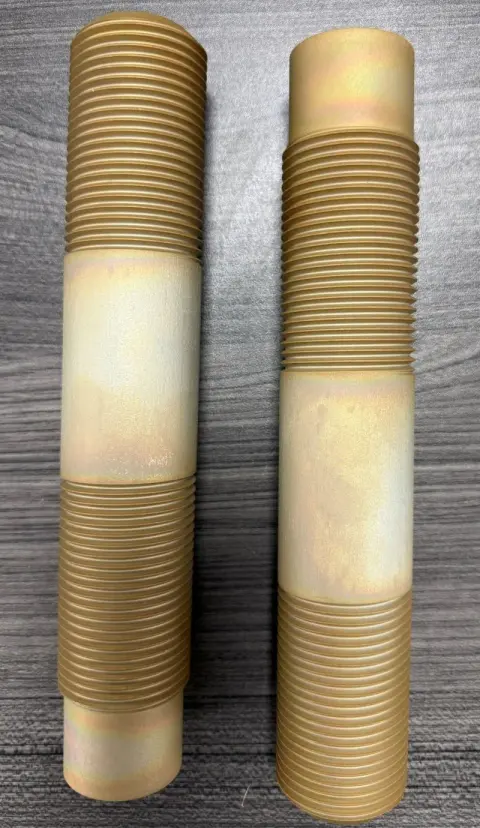
- Full-thread studs and stud bolts
- Double-end and tap-end studs
- Hex and heavy hex bolts
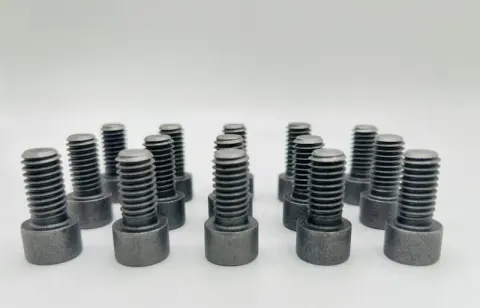
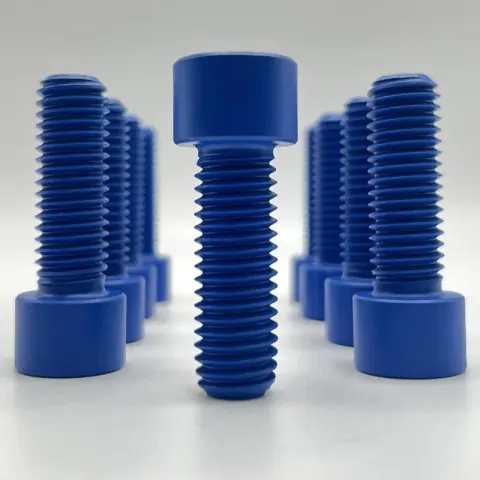
- Socket head cap screws
- Threaded rod (cut and rolled thread)
- Machined components from certified bar
A193 B7M fasteners we make.
Every item is manufactured to your drawing or standard in A193 B7M, imperial or metric, with an EN 10204 3.1 certificate.
What is ASTM A193 B7M?
B7M is Grade B7 with a modified heat treatment: a higher tempering temperature that softens the steel to a maximum of 235 HBW (about 22 HRC) and a minimum tensile strength of 100 ksi. Chemistry, bar stock and manufacturing route are identical to B7; the difference is entirely in the temper and in the inspection regime, which requires every single fastener to be hardness tested.
The 22 HRC limit is the threshold NACE MR0175 sets for carbon and low-alloy steels exposed to wet hydrogen sulfide. Above it, the steel becomes vulnerable to sulfide stress cracking; below it, B7M has decades of sour-service history.
Why tempering after threading matters
A193 requires the final temper to happen after machining, threading and cutting. Rolling or cutting threads on already-tempered bar cold works the surface and can push the thread root above the hardness limit even when the core passes. Studs made the shortcut way may read fine on a Brinell test of the body and still fail a microhardness check at the thread. We machine and thread first, heat treat second, then test.
Matching nuts for sour service
B7M studs are paired with ASTM A194 Grade 2HM nuts, which carry the same 235 HBW hardness cap and a 150 ksi proof load. Grade 7M is the chromium-moly alternative for higher temperatures. Do not mix B7M studs with standard 2H nuts on a sour line; the nut is exposed to the same environment and has to meet the same hardness limit.
Coatings
Fluoropolymer (PTFE) coatings are common on B7M bolting because sour lines are often offshore or in coastal plants. Hot-dip galvanizing and zinc plating are also available. As with B7, the hardness is well below the embrittlement threshold, so galvanizing does not require a post-plating bake.
Testing, certification and marking
- 100 percent hardness testing on the finished product, recorded on the certificate
- Tensile testing per heat-treat lot; NACE MR0175 compliance statement on request
- Grade symbol B7M and manufacturer's identification on every piece
- EN 10204 3.1 material test report; 3.2 witness and PMI available
ASTM A193 Grade B7
The workhorse alloy-steel bolting grade for flanges, valves and pressure equipment — 125 ksi tensile, quenched and tempered 4140.
ASTM A194 / ASME SA-194ASTM A194 Grade 2HM
The sour-service heavy hex nut — 2H tempered to 235 HBW max for NACE MR0175, matched to A193 B7M and A320 L7M studs.
ASTM A320 / ASME SA-320ASTM A320 Grade L7M
Controlled-hardness L7 for cold sour service — 22 HRC max, NACE MR0175 compliant, Charpy tested at −100 °F.