

316 Stainless Steel (UNS S31600)
The marine and chemical-plant stainless: 2 to 3 percent molybdenum for pitting and crevice resistance in chlorides, with the same strength tables as 304.
What 316 Stainless is.
Type 316 adds 2 to 3 percent molybdenum and a little more nickel to the 18-8 base. Molybdenum stabilizes the passive film against chloride attack, so 316 resists the pitting and crevice corrosion that 304 suffers in seawater, brine, deicing salt and many process chemicals. Strength, magnetism and cryogenic toughness are the same as 304, and it sits in ASTM F593 Alloy Group 2.
We machine 316 bolts, studs, nuts and components from certified A276 bar and supply them to any F593 condition. For pressure flanges the same alloy is ordered as ASTM A193 B8M or A320 B8M.
Chemical composition.
| Element | Symbol | Min % | Max % |
|---|---|---|---|
| Carbon | C | — | 0.08 |
| Manganese | Mn | — | 2.00 |
| Phosphorus | P | — | 0.045 |
| Sulfur | S | — | 0.030 |
| Silicon | Si | — | 1.00 |
| Chromium | Cr | 16.0 | 18.0 |
| Nickel | Ni | 10.0 | 14.0 |
| Molybdenum | Mo | 2.00 | 3.00 |
Values per ASTM A276/A276M-17 Tables 1 and 2 (verified against the specification). Confirm the edition called out on your purchase order with our estimating team.
Mechanical properties.
| Condition and nominal diameter (in.) | Tensile strength, min (ksi) | Yield strength 0.2% offset, min (ksi) | Elongation, min (%) | Reduction of area, min (%) | Hardness |
|---|---|---|---|---|---|
| Condition A (annealed), hot finished — all | 75 | 30 | 40 | 50 | — |
| Condition A, cold finished — ½ and under | 90 | 45 | 30 | 40 | — |
| Condition A, cold finished — over ½ | 75 | 30 | 30 | 40 | — |
| Condition B (cold worked) — ¾ and under | 125 | 100 | 12 | 35 | — |
| Condition B — over ¾ to 1 | 115 | 80 | 15 | 35 | — |
| Condition B — over 1 to 1¼ | 105 | 65 | 20 | 35 | — |
| Condition B — over 1¼ to 1½ | 100 | 50 | 24 | 45 | — |
| Condition B — over 1½ to 1¾ | 95 | 45 | 28 | 45 | — |
| Condition S (strain hardened) — 2 and under | 95 | 75 | 25 | 40 | — |
| Condition S — over 2 to 2½ | 90 | 65 | 30 | 40 | — |
| Condition S — over 2½ to 3 | 80 | 55 | 30 | 40 | — |
Values per ASTM A276/A276M-17 Tables 1 and 2 (verified against the specification). Confirm the edition called out on your purchase order with our estimating team. Condition B and S limits are shared with 304.
| F593 condition · marking | Nominal diameter (in.) | Tensile strength (ksi) | Yield strength, min (ksi) | Rockwell hardness |
|---|---|---|---|---|
| AF (annealed after forming) · F593E | ¼ to 1½ | 65 to 85 | 20 | B85 max |
| A (annealed) · F593F | ¼ to 1½ | 75 to 100 | 30 | B65 to B95 |
| CW1 (cold worked) · F593G | ¼ to ⅝ | 100 to 150 | 65 | B95 to C32 |
| CW2 (cold worked) · F593H | ¾ to 1½ | 85 to 140 | 45 | B80 to C32 |
| SH1 (strain hardened) · F593E | ¼ to ⅝ | 120 to 160 | 95 | C24 to C36 |
| SH2 (strain hardened) · F593F | ¾ to 1 | 110 to 150 | 75 | C20 to C32 |
| SH3 (strain hardened) · F593G | 1⅛ to 1¼ | 100 to 140 | 60 | B95 to C30 |
| SH4 (strain hardened) · F593H | 1⅜ to 1½ | 95 to 130 | 45 | B90 to C28 |
Values per ASTM F593-24 Table 2, full-size tests (verified against the specification). Yield is 0.2 % offset; hardness is Rockwell. Machined-specimen limits differ slightly.
Specifications that apply.
How 316 Stainless ships from Houston.
- Hex and heavy hex bolts and cap screws
- Full-thread studs and threaded rod
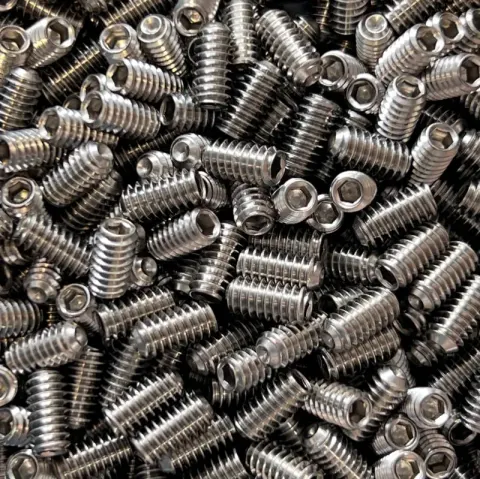
- Socket head cap and set screws
- Hex, jam and lock nuts
- Washers and spacers
- Machined components from certified bar
316 Stainless fasteners we make.
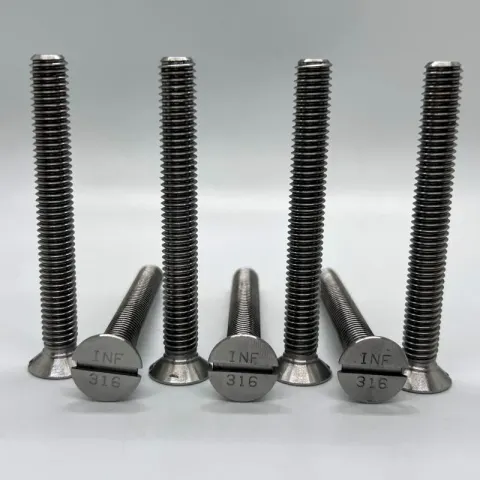
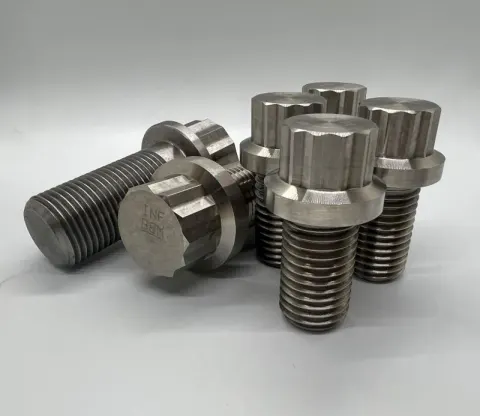
Every item is manufactured to your drawing or standard in 316 Stainless, imperial or metric, with an EN 10204 3.1 certificate.
What is 316 stainless steel?
316 is the second most common stainless steel and the one to reach for when chlorides are present. Its molybdenum content raises the pitting resistance well above 304, to a pitting resistance equivalent number of about 25 against 19. Everything else follows the 18-8 pattern: austenitic, non-magnetic when annealed, tough at cryogenic temperature, and strengthened only by cold work.
316 versus 304
- Seawater, brine, deicing salt, chlorinated water or acidic process streams: 316.
- Fresh water, food service, atmosphere away from the coast: 304 performs the same for less.
- Strength is identical in every condition, so the choice is corrosion, not load.
- Above 1500 °F neither is suitable; below −325 °F both are, with 316 impact exempt to −325 °F under A320.
Galling and thread lubrication
316 galls like every austenitic stainless. We supply anti-seize, PTFE-coated studs, silver-plated nuts, or a Nitronic 60 nut for joints that are assembled repeatedly.
Testing, certification and marking
- Tensile and hardness tested per lot on the finished product
- Grade or marking symbol F593E to F593H and manufacturer's identification on every piece
- EN 10204 3.1 material test report with heat number and chemistry; 3.2 witness available
- PMI verification and intergranular corrosion testing (ASTM A262) arranged on request
316L Stainless Steel (UNS S31603)
316 with carbon held to 0.030 percent for welded and heated service in chloride environments — the standard grade for pharmaceutical, chemical and offshore skids.
ASTM A276 bar · ASTM F593 bolts304 Stainless Steel (UNS S30400)
The general-purpose 18-8 stainless: 75 ksi annealed bar, cold-worked bolts to 160 ksi, non-magnetic, and resistant to water, food and most mild chemicals.
ASTM A193 / ASME SA-193ASTM A193 Grade B8M Class 1 (316 Stainless)
316 stainless bolting with molybdenum for chloride and pitting resistance — offshore, marine, chemical and coastal plant fasteners.