

Nimonic® 80A (UNS N07080)
The exhaust-valve and turbine-bolting superalloy: an 80/20 nickel-chromium alloy age hardened by titanium and aluminium, creep resistant to 1500 °F.
What Nimonic 80A is.
Nimonic 80A is a wrought nickel-chromium alloy, about 80 percent nickel and 20 percent chromium, strengthened by gamma-prime precipitates of titanium and aluminium. It was one of the first superalloys developed for gas-turbine blades and remains the standard material for engine exhaust valves, turbine bolting, springs and hot-section hardware, with useful creep and rupture strength to about 1500 °F and excellent oxidation resistance. It is non-magnetic and retains ductility at cryogenic temperature.
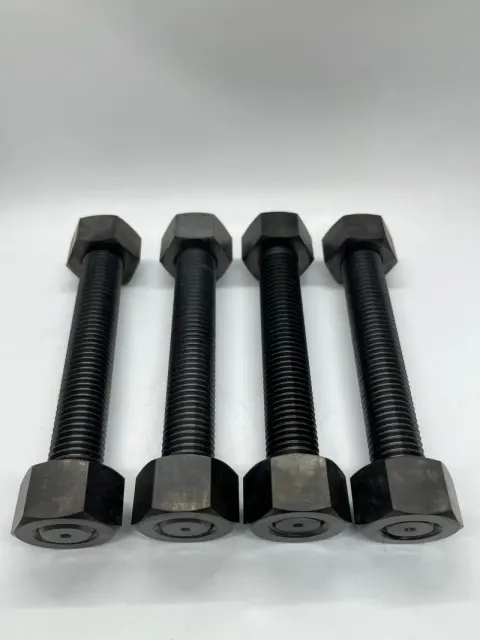
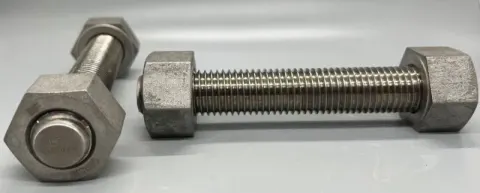
We machine Nimonic 80A studs, bolts, nuts and components from certified B637 bar, supplied solution treated for machining and fully heat treated to the specification, with PMI on every lot.
Chemical composition.
| Element | Symbol | Min % | Max % |
|---|---|---|---|
| Carbon | C | — | 0.10 |
| Manganese | Mn | — | 1.00 |
| Silicon | Si | — | 1.00 |
| Sulfur | S | — | 0.015 |
| Chromium | Cr | 18.00 | 21.00 |
| Titanium | Ti | 1.80 | 2.70 |
| Aluminium | Al | 0.50 | 1.80 |
| Iron | Fe | — | 3.00 |
| Nickel | Ni | balance | — |
Values per ASTM B637-16 Tables 1 and 3 (verified against the specification). Confirm the edition called out on your purchase order with our estimating team.
Mechanical properties.
| Condition | Tensile strength, min (ksi) | Yield strength 0.2% offset, min (ksi) | Elongation, min (%) | Reduction of area, min (%) | Hardness |
|---|---|---|---|---|---|
| Solution treated + stabilized + precipitation hardened — all | 135 | 90 | 20 | — | — |
Values per ASTM B637-16 Tables 1 and 3 (verified against the specification). Confirm the edition called out on your purchase order with our estimating team.
Specifications that apply.
How Nimonic 80A ships from Houston.
- Studs and stud bolts
- Hex and heavy hex bolts
- Nuts and washers
- Springs and pins
- Machined components from certified bar
Nimonic 80A fasteners we make.
Every item is manufactured to your drawing or standard in Nimonic 80A, imperial or metric, with an EN 10204 3.1 certificate.
What is Nimonic 80A?
Nimonic 80A is the founding member of the Nimonic family, developed in Britain in the 1940s for the first jet-engine turbine blades. It is a simple alloy by superalloy standards: an 80/20 nickel-chromium matrix, which gives outstanding oxidation resistance, hardened by titanium and aluminium precipitates that keep it strong and creep resistant to about 1500 °F. Its long production history means it is widely stocked in bar, and it remains the reference material for engine exhaust valves and for turbine bolting at temperatures that defeat A193 B16 and 422 stainless.
80A, 718 or X-750?
- 718 is stronger to 1200 °F and easier to weld, but its strength falls away faster above that; 80A holds on to 1500 °F.
- X-750 is a close cousin with similar strength; 80A has better oxidation resistance and is the usual choice on European and turbine OEM drawings.
- For bolting above 1300 °F, 80A and Waspaloy are the practical options; below that, 718 is normally the economical pick.
Testing, certification and marking
- Tensile and hardness tested per heat-treat lot; ASTM B637 Table 4 also requires a stress-rupture test per lot (1400 °F, 47 ksi, 23 h minimum)
- Alloy symbol and manufacturer's identification on every piece
- EN 10204 3.1 material test report with heat number and chemistry; 3.2 witness available
- PMI verification standard on nickel alloys
Inconel 718 (UNS N07718)
The premier high-strength nickel superalloy — 185 ksi tensile and 150 ksi yield from cryogenic temperatures to 1200 °F, with corrosion and sour-gas resistance to match.
ASTM B637Inconel® X-750 (UNS N07750)
The spring and fastener superalloy: age hardened to 170 ksi, holds its strength to 1300 °F and stays tough at cryogenic temperature — for turbine bolting, springs and nuclear and rocket hardware.
ASTM A453 / ASME SA-453ASTM A453 Grade 660 (A-286)
A-286 bolting for the hottest joints — 130 ksi at room temperature and rated by stress-rupture at 1200 °F, for gas and steam turbines, exhaust and high-temperature process equipment.