

ASTM A320 Grade B8M Class 2 (316 Strain Hardened)
Strain-hardened 316 bolting certified to A320 — 110 ksi tensile in ¾ in. and under, for cold-service joints that need chloride resistance and bolt strength together.
What A320 B8M Class 2 is.
Everything in this grade is the same steel as ASTM A193 B8M Class 2: identical 316 chemistry, the same heat treatment classes and the same room-temperature strength table. What A320 adds is the framework for cold service — impact testing rules, the requirement that nuts come from the matching austenitic A194 grade, and certification to a specification that piping and vessel codes call out for sub-zero design temperatures. A320 does not include the B8M2 and B8M3 large-diameter classes, so A320 B8M Class 2 stops at 1½ in.
Class 2 B8M is the choice for offshore and LNG terminal flanges where a 316 bolt must carry loads that annealed material cannot. Impact exemption for Class 2 ends at −325 °F; below that, criteria are agreed on the order. We supply it from strain-hardened certified 316 bar, marked B8MSH, with A194 Grade 8M nuts.
Chemical composition.
| Element | Symbol | Min % | Max % |
|---|---|---|---|
| Carbon | C | — | 0.08 |
| Manganese | Mn | — | 2.00 |
| Phosphorus | P | — | 0.045 |
| Sulfur | S | — | 0.030 |
| Silicon | Si | — | 1.00 |
| Chromium | Cr | 16.0 | 18.0 |
| Nickel | Ni | 10.0 | 14.0 |
| Molybdenum | Mo | 2.00 | 3.00 |
Values per ASTM A320/A320M-26, Tables 1 and 3 (verified against the specification). Confirm the edition called out on your purchase order with our estimating team.
Mechanical properties.
| Nominal diameter (in.) | Tensile strength, min (ksi) | Yield strength 0.2% offset, min (ksi) | Elongation in 2 in., min (%) | Reduction of area, min (%) | Hardness, max |
|---|---|---|---|---|---|
| Class 2 — ¾ and under | 110 | 95 | 15 | 45 | 321 HBW / 35 HRC |
| Class 2 — over ¾ to 1 | 100 | 80 | 20 | 45 | 321 HBW / 35 HRC |
| Class 2 — over 1 to 1¼ | 95 | 65 | 25 | 45 | 321 HBW / 35 HRC |
| Class 2 — over 1¼ to 1½ | 90 | 50 | 30 | 45 | 321 HBW / 35 HRC |
Values per ASTM A320/A320M-26, Tables 1 and 3 (verified against the specification). Confirm the edition called out on your purchase order with our estimating team. Class 2 is limited to 1½ in. Strain-hardened austenitic steel may not show uniform properties through the section, particularly over ¾ in. diameter.
| Grade and class | Impact test exempt above | Below that temperature |
|---|---|---|
| B8, B8C, B8P, B8LN — Class 1 and 1A | −425 °F (−254 °C) | Impact tested to agreed criteria |
| B8M, B8T, B8F, B8MLN — Class 1 and 1A | −325 °F (−198 °C) | Impact tested to agreed criteria |
| All austenitic grades — Class 2 | −325 °F (−198 °C) | Impact tested to agreed criteria |
| Any grade ½ in. and smaller | Exempt at all temperatures | Unless S1 is specified |
Per ASTM A320/A320M-26 (verified against the specification). When impact tests are required for austenitic grades, the test temperature and acceptance criteria are agreed between purchaser and supplier; Supplementary Requirement S1 may be ordered.
Specifications that apply.
How A320 B8M Class 2 ships from Houston.
- Full-thread studs and stud bolts
- Double-end and tap-end studs
- Hex and heavy hex bolts
- Socket head cap screws
- Threaded rod (cut and rolled thread)
- Machined components from certified bar
A320 B8M Class 2 fasteners we make.
Every item is manufactured to your drawing or standard in A320 B8M Class 2, imperial or metric, with an EN 10204 3.1 certificate.
What is ASTM A320 B8M Class 2?
A320 B8M Class 2 is 316 stainless that has been solution treated and cold worked to raise its strength, certified for low-temperature service. The strength table is the A193 B8M Class 2 table: 110 ksi tensile in ¾ in. and under, stepping to 90 ksi at 1½ in. Because A320 lists no Class 2B or 2C for austenitic grades, larger diameters are ordered as Class 1 under A320 or as B8M2 / B8M3 under A193.
Impact testing under A320
- Class 1, 1A and Class 2 B8M are exempt from impact testing above −325 °F. Below that, the test temperature and acceptance values are agreed between purchaser and supplier, or ordered under Supplementary Requirement S1.
- Class 2 (strain hardened) austenitic bolting is exempt above −325 °F.
- Bolting ½ in. and smaller is exempt at all temperatures unless S1 is specified.
- Nuts follow 10.2: matching A194 austenitic grades, with the same exemption temperatures.
Why order to A320 instead of A193?
The mechanical numbers are the same, so the choice comes down to what the design code and the purchaser's specification ask for. ASME B31.3 and Section VIII list SA-320 for bolting below the A193 minimum temperatures, and an A320 certificate carries the impact-test statement, or the exemption under 6.2.1.1, that a low-temperature package needs. Ordering A320 also brings in 10.2, which requires austenitic A194 nuts of the matching grade and states when those nuts must be impact tested. Dual-certified A193/A320 bolting is available on request when a stock item must serve both.
Testing, certification and marking
- Tensile and hardness tested per lot on the finished product
- Grade symbol B8MSH and manufacturer's identification on every piece
- EN 10204 3.1 material test report with heat number and chemistry; 3.2 witness available
- Hardness checked on the finished product; 321 HBW / 35 HRC maximum
- Impact test results, or the 6.2.1.1 exemption, stated on the certificate
Recent A320 B8M Class 2 jobs.
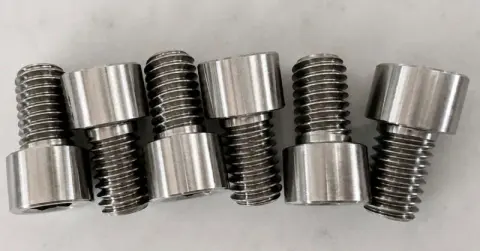
ASTM A320 Grade B8M Class 1 (316 Stainless)
316 stainless bolting certified to the low-temperature specification — chloride resistance for LNG terminals and coastal cold service, impact exempt above −325 °F.
ASTM A193 / ASME SA-193ASTM A193 Grade B8M Class 2 (316 Strain Hardened)
316 stainless bolting cold worked after solution treatment — 110 ksi tensile in ¾ in. and under, with B8M2 and B8M3 classes for diameters to 3 in. and beyond.
ASTM A320 / ASME SA-320ASTM A320 Grade B8 Class 2 (304 Strain Hardened)
Strain-hardened 304 bolting certified to A320 — 125 ksi tensile in ¾ in. and under, for cryogenic joints that need more bolt strength than annealed stainless.