

ASTM A193 Grade B7
The workhorse alloy-steel bolting grade for flanges, valves and pressure equipment — 125 ksi tensile, quenched and tempered 4140.
What A193 B7 is.
ASTM A193 Grade B7 is a quenched-and-tempered chromium-molybdenum alloy steel and the most specified bolting material in the process industries. It combines high strength with good toughness across the range of temperatures that flanged piping, valves, pumps and pressure vessels normally see, which is why it is the default stud-bolt grade under ASME B16.5 and B31.3.
We manufacture B7 studs, bolts, screws and machined parts from certified 4140/4142 bar, heat treated to the specification and tempered at 1100 °F minimum, with threads rolled or cut after heat treatment. Every lot ships with an EN 10204 3.1 material test report tying the finished part back to its heat.
Chemical composition.
| Element | Symbol | Min % | Max % |
|---|---|---|---|
| Carbon | C | 0.38 | 0.48 |
| Manganese | Mn | 0.75 | 1.00 |
| Phosphorus | P | — | 0.035 |
| Sulfur | S | — | 0.040 |
| Silicon | Si | 0.15 | 0.35 |
| Chromium | Cr | 0.80 | 1.10 |
| Molybdenum | Mo | 0.15 | 0.25 |
Values per ASTM A193/A193M-24, Tables 1 and 2 (verified against the specification). Confirm the edition called out on your purchase order with our estimating team.
Mechanical properties.
| Nominal diameter (in.) | Tensile strength, min (ksi) | Yield strength 0.2% offset, min (ksi) | Elongation in 4D, min (%) | Reduction of area, min (%) | Hardness, max |
|---|---|---|---|---|---|
| 2½ and under | 125 | 105 | 16 | 50 | 321 HBW / 35 HRC |
| Over 2½ to 4 | 115 | 95 | 16 | 50 | 321 HBW / 35 HRC |
| Over 4 to 7 | 100 | 75 | 18 | 50 | 321 HBW / 35 HRC |
Values per ASTM A193/A193M-24, Tables 1 and 2 (verified against the specification). Confirm the edition called out on your purchase order with our estimating team.
Specifications that apply.
How A193 B7 ships from Houston.
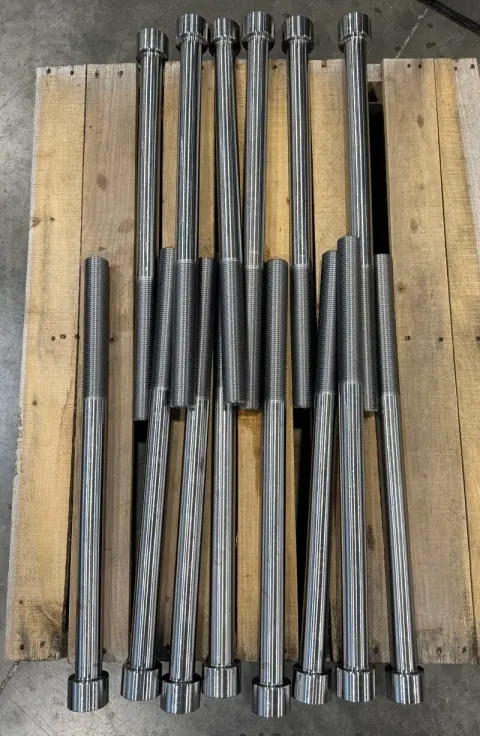
- Full-thread studs and stud bolts
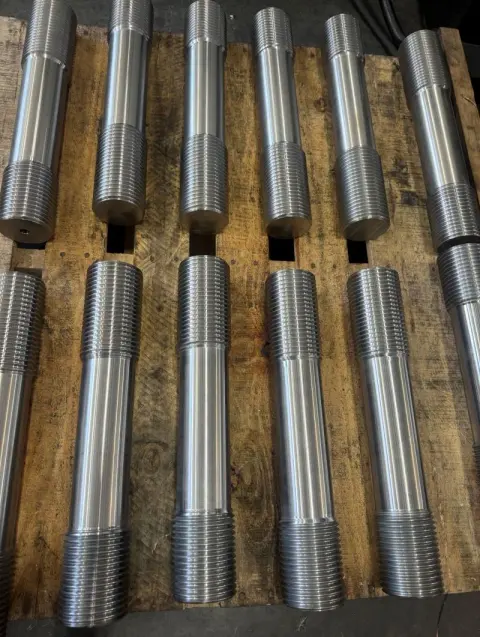
- Double-end and tap-end studs
- Hex and heavy hex bolts
- Socket head cap screws
- Threaded rod (cut and rolled thread)
- Machined components from certified bar
A193 B7 fasteners we make.
Every item is manufactured to your drawing or standard in A193 B7, imperial or metric, with an EN 10204 3.1 certificate.
What is ASTM A193 B7?
ASTM A193 is the specification for alloy-steel and stainless steel bolting intended for high-temperature or high-pressure service. Grade B7 is its chromium-molybdenum member, produced from AISI 4140, 4142 or 4145 bar that is hardened by quenching and then tempered to a controlled strength range. The result is a fastener with a minimum tensile strength of 125 ksi in diameters up to 2½ inches, a capped hardness of 35 HRC to preserve toughness, and reliable performance at the elevated temperatures found in steam, hydrocarbon and utility piping.
The grade is stamped on every finished part together with the manufacturer's identification, so a B7 stud can be traced on the flange without paperwork. Its ASME equivalent, SA-193 B7, is the version called out in the Boiler & Pressure Vessel Code.
B7 versus B7M
B7M is the same steel tempered further, to a maximum of 235 HBW (roughly 22 HRC) and a minimum tensile strength of 100 ksi. The lower hardness makes B7M suitable for sour (H₂S) service under NACE MR0175 / ISO 15156, where harder B7 is prohibited. B7M also carries a 100 percent hardness-testing requirement rather than a sample. If the line is sour, specify B7M and A194 2HM nuts; if it is not, B7 with 2H nuts gives you roughly 25 percent more strength for the same size.
Choosing nuts and washers
The standard pairing is ASTM A194 Grade 2H heavy hex nuts, which are proof-load rated at 175 ksi and hardened to match the stud. Grade 7 nuts (Cr-Mo, the same base steel as B7) are used where the nut must see the same elevated temperature as the stud, and Grade 4 is an older carbon-moly option that is still called out on some legacy drawings. Hardened washers to ASTM F436 are the usual companion; through-hardened washers keep the bolt load where it belongs on flanges that have seen a few turnarounds.
Coatings and finishes
B7 is supplied plain (black, as heat treated), zinc electroplated, hot-dip galvanized, or with a fluoropolymer coating such as PTFE (Xylan®) in the familiar blue or green. Because B7 hardness is capped at 35 HRC it is not considered susceptible to hydrogen embrittlement from galvanizing, unlike higher-strength grades. PTFE coatings lower the friction coefficient noticeably, so torque values calculated for plain studs must be recalculated for coated ones.
Testing, certification and marking
- Tensile, yield, elongation and reduction of area tested on the finished heat-treat lot
- Hardness checked on the finished product; 100 percent testing available on request
- Grade symbol B7 and manufacturer's identification applied to one end of every stud or the head of every bolt
- EN 10204 3.1 material test report with heat number, chemistry and mechanicals on every lot; 3.2 third-party witness available
- PMI, Charpy impact and NACE compliance testing arranged through our laboratory partners
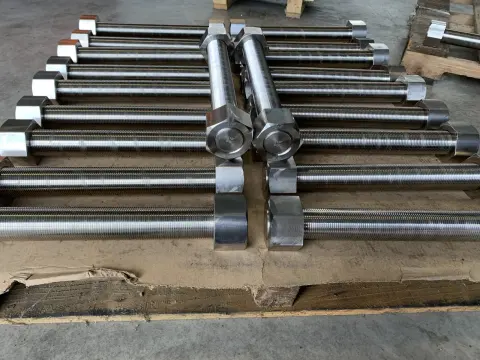
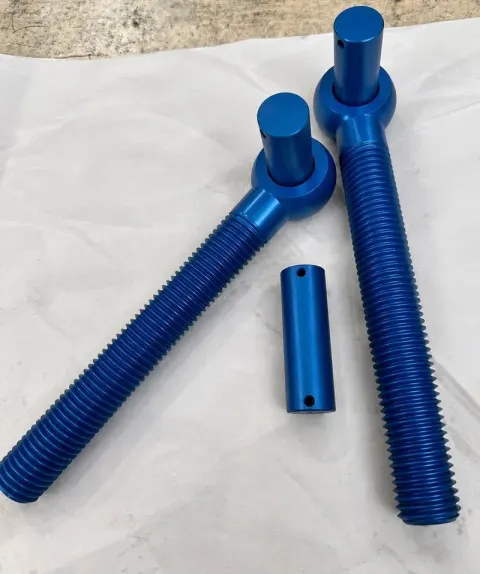
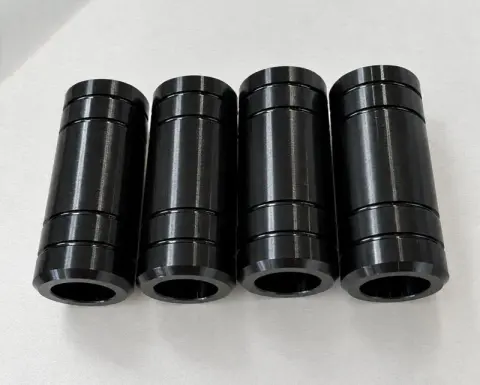
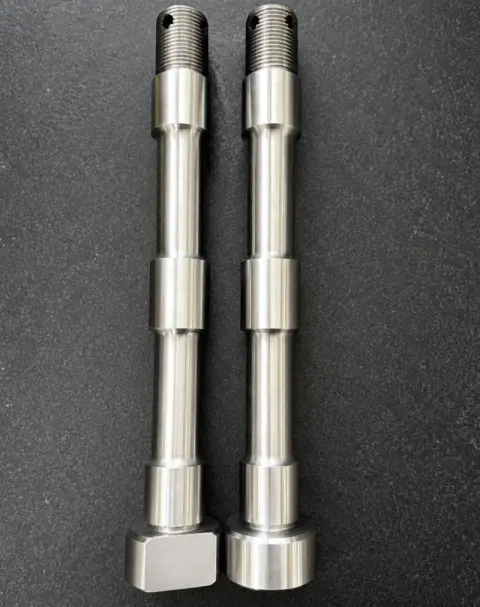
Recent A193 B7 jobs.
ASTM A193 Grade B7M
B7 tempered to 22 HRC max for sour service — the NACE MR0175 bolting grade for wellheads, sour gas and H₂S process piping.
ASTM A194 / ASME SA-194ASTM A194 Grade 2H
The standard heavy hex nut for A193 B7 studs — quenched and tempered carbon steel, 175 ksi proof load, 24 to 35 HRC.
ASTM A320 / ASME SA-320ASTM A320 Grade L7
The low-temperature twin of B7 — same 4140 Cr-Mo steel, same 125 ksi strength, but impact tested at −150 °F for cryogenic and cold-climate service.