

PTFE / fluoropolymer coating
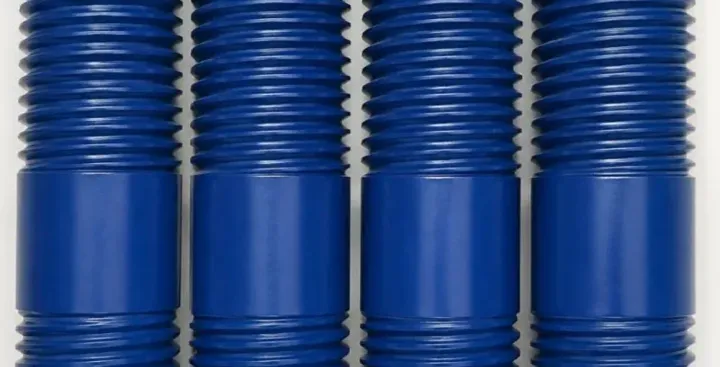
A PTFE fluoropolymer coating is a thin, oven-cured film, usually laid over a phosphate base. It lowers thread friction and resists galling, and as a barrier film it keeps weather and chemical splash off the stud. It is applied by outside Houston coaters to the customer's coating specification.
Clean, blast, phosphate, coat, cure.
- STEP 01
Clean
The coater degreases the studs and nuts.
- STEP 02
Blast
Abrasive blasting removes rust and scale. Heavy-phosphate specifications require it unless the order says otherwise, with the phosphate following straight after.
- STEP 03
Phosphate
A zinc or manganese phosphate is formed on the steel by immersion. A heavy phosphate is meant to hold the coatings put over it.
- STEP 04
Apply the fluoropolymer
The resin-bonded PTFE coating goes on over the phosphate as a thin liquid film, to the thickness the coating specification calls for.
- STEP 05
Cure
An oven bake cures the resin and bonds the film, at the time and temperature the coating maker sets.
- STEP 06
Check, pair and tag
When the order asks for it, film thickness is measured on the parts and reported on the certificate. Studs and nuts are then paired, boxed and tagged.
- Hot flanges: one widely used grade is rated to 350 °F (175 °C) continuous and 400 °F (204 °C) for short periods. Above that, check the coating system's rating or choose another finish.
- Torque: the same torque gives more tension on coated studs than on plain or oiled ones, so tightening values have to be set for the coated parts.
- It is a barrier film over phosphate, not a sacrificial coating. One maker notes better corrosion protection when it goes over a sacrificial zinc layer.
- Oversize-tapped nuts have less thread in contact, so the overtap should be agreed and named on the order.
Finishes are applied by outside coaters and platers in Houston, to the specification on the order.
A low-friction film, with nuts tapped to make room.
A 1 mil (25 µm) film is twice the 0.0005 in. that ASTM F1941 lets zinc plating take up on a 1-8 class 2A thread. The nuts are therefore tapped oversize to make room for the coating. No ASTM rule sets that overtap, so it is agreed with the coater and named on the order.
Lower friction means more bolt tension for the same torque, so torque values for plain or oiled studs do not carry over. One coating maker advises measuring the tension, for example with direct tension indicators, to set the make-up torque for each size or lot.
Phosphating is an acid process, so steel of 39 HRC and above gets a hydrogen relief treatment after it. B7 and L7 studs and 2H and Grade 7 nuts, at 35 HRC maximum, are below that line. Heat is the other limit: one widely used fastener grade is rated for continuous service from −60 to 350 °F (−50 to 175 °C), and to 400 °F (204 °C) for short periods.
Designations and classes.
How to call it out.
- Give the bolting, the coating system or specification, the colour and the film thickness, for example: 1-8 x 7-1/2 in. ASTM A193 B7 studs, each with two ASTM A194 2H heavy hex nuts, zinc phosphate plus PTFE fluoropolymer, blue, 1 mil (25 µm) nominal.
- Say that the nuts are to be tapped oversize for the coating, and by how much if your specification sets it.
- Ask for film thickness readings on the certificate if you need them.
PTFE / fluoropolymer coating: common questions.
Why are coated studs blue or green?
The colour is pigment chosen by the buyer; fluoropolymer fastener coatings come in many colours. The colour does not identify the bolting grade.
Is the tightening torque the same as for plain studs?
No. The coating lowers thread friction, so the same torque produces more bolt tension. Set the torque for the coated parts, from your procedure or a tension measurement.
Does the PTFE replace the phosphate?
No. The phosphate stays underneath as the base the film holds on to, and the two are tested together. One maker's fastener grade, at 1 mil (25 µm) over zinc phosphate, exceeded 1,500 hours of ASTM B117 salt spray with less than 15% red rust.
Can PTFE-coated bolting go on hot service?
Only within the coating's rating. One widely used grade is rated to 350 °F (175 °C) continuous and 400 °F (204 °C) intermittent.
Compare with.
Phosphate and oil
A manganese or zinc phosphate conversion coating that holds oil in its crystalline surface. It gives a dark grey to black finish, mild corrosion protection in storage and transit, and a good base for PTFE or paint.
Economical sacrificial protection for indoor and mild serviceZinc electroplating
A thin electroplated zinc layer with a clear, yellow or black chromate, or a chromium-free passivate. Zinc corrodes in preference to the steel underneath, so a scratch does not rust. It is the general-purpose finish for hardware that lives indoors or under cover.
High corrosion resistance without hydrogen from platingZinc-flake coating
A sprayed or dipped coating of zinc and aluminium flakes in a binder, cured rather than plated. Because it is not electroplated, the coating process itself puts no hydrogen into the steel, which makes it a common choice for high-strength bolting that needs long salt-spray life.