

Zinc electroplating
Zinc electroplating deposits a thin layer of zinc on the steel and finishes it with a conversion coat. The zinc corrodes before the steel does, so a scratch does not rust straight away. For bolts, studs and nuts the specification is ASTM F1941, which sets the thickness classes, the finishes and the bake that hard parts need. The plating is done by outside Houston platers.
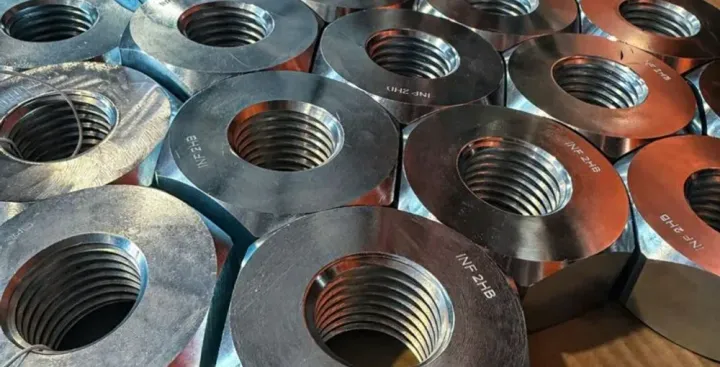
Clean, plate, bake, convert.
- STEP 01
Clean and activate
The plater removes oil in alkaline cleaners and oxide in inhibited acid. Parts of 40 HRC and above are better cleaned abrasively, to keep hydrogen out.
- STEP 02
Plate
Small parts tumble through the baths in a barrel; larger ones hang on racks, which spares the threads and gives a more even coat. The zinc builds up most where the current concentrates, at the ends and edges.
- STEP 03
Bake if hard
Parts with a specified hardness over 39 HRC are baked soon after plating, before the conversion coat: at least 14 hours up to 44 HRC and 24 hours above, at 375 to 425 °F (190 to 220 °C).
- STEP 04
Convert
Baked zinc is reactivated in a mild acid dip, then all parts get a clear, blue-bright, yellow, olive or black conversion coat, with or without hexavalent chromium.
- STEP 05
Seal or lubricate
Where ordered, a sealant or a top coat with built-in lubricant goes on last, for extra corrosion resistance or controlled torque-tension.
- STEP 06
Check
Thickness is measured on the significant surfaces, the threads must still take a basic-size GO gauge, and salt spray is run when the order calls for it.
- Outdoors: at 5 µm, F1941 asks for only 24 hours to red rust in salt spray with a clear finish and 96 hours with yellow. Hot-dip galvanizing carries about ten times as much zinc.
- Hardness: electroplating is not recommended over 39 HRC or on case-hardened parts (ASTM F1941). Steel over 1700 MPa (46 HRC) should not be zinc-plated to B633 at all.
- Heat: zinc-coated bolting should stay below about 390 °F (210 °C), where liquid and solid metal embrittlement become a risk (ASTM A193, A194).
- Thread room: classes 8 and 12 need threads made for them, because a standard class 2A thread has room only for a thin coat.
Finishes are applied by outside coaters and platers in Houston, to the specification on the order.
Thin enough to fit, thick enough to protect.
Plating builds up on both flanks, so a 60° thread's pitch diameter grows by about four times the plating thickness. A class 2A bolt thread is made slightly under basic size to leave room for it, and ASTM F1941 keeps the plating to a quarter of that allowance. That is about 0.000375 in. at the tip of a 1/2-13 thread and 0.0005 in. on a 1-8. After plating, the thread must still accept a basic-size class 3A GO gauge, and the NOT-GO gauge does not change.
That is why Fe/Zn 5, 0.0002 in. (5 µm), is the usual class for bolts. Fe/Zn 12 by barrel plating is not recommended on standard threads, and ASTM B633 notes that most threaded parts cannot take much more than 8 µm. Heavier zinc needs threads made undersize before plating. Standard nut threads have no allowance at all, so a nut to be plated is tapped to suit first.
Cleaning and plating put hydrogen into the steel. Below 39 HRC, which covers B7 studs and 2H nuts at 35 HRC maximum, it is not a significant risk and no bake is required. Above it, F1941 makes the bake mandatory and still does not recommend electroplating, because baking reduces the risk but cannot remove it. ASTM B633 has the bake start within 4 hours of plating.
Designations and classes.
How to call it out.
- Name the specification and the full code, for example ASTM F1941, Fe/Zn 5C for yellow zinc, or Fe/Zn 5AN where hexavalent chromium is not allowed.
- Give the grade or specified hardness. A bake is required over 39 HRC, and you can ask for one below it.
- For parts that are not fasteners, give the B633 service condition and Type, for example ASTM B633, SC 2, Type V.
- Ask for thickness readings and salt spray results on the certificate if you need them.
The tests behind it.
Coating thickness and salt spray
Coating thickness is measured with a magnetic or eddy-current gauge, or by X-ray fluorescence for thin platings, and checked against the class ordered. Salt-spray exposure checks corrosion protection on a sample from the lot when the specification calls for it.
Will a plated high-strength bolt crack in service?Hydrogen embrittlement relief and testing
High-strength steel can pick up hydrogen during pickling and plating and fail days later under load. Parts above 39 HRC are baked after plating to drive the hydrogen out, and a sustained-load test on fasteners from the lot proves the relief worked.
Does every dimension and thread meet the drawing?Thread gauging and dimensional inspection
Threads are checked with Go and No-Go ring and plug gauges, and pitch diameter is measured by the three-wire method or on a thread comparator. Heads, flats, lengths and radii are measured with calibrated instruments and, for complex parts, on the CMM.
Zinc electroplating: common questions.
Does a zinc-plated B7 stud need a hydrogen bake?
Not under ASTM F1941. B7 is 35 HRC maximum, and the bake is mandatory only where the specified hardness is over 39 HRC. You can still ask for one on the order.
F1941 or B633?
F1941 is written for threaded fasteners and is used in place of B633 for them; its classes stop at 12 µm. B633 covers other iron and steel parts and goes up to 25 µm.
Clear or yellow?
Yellow lasts longer. At 5 µm, F1941 asks for 96 hours to red rust in salt spray with yellow (C) and 24 hours with clear (A). Chromium-free yellow needs a sealant to match, because a yellow dye on a trivalent passivate does not give the same protection.
Will plated threads still gauge?
They have to. A plated bolt must accept a basic-size GO gauge, and the NOT-GO gauge is the same as before plating (ASTM F1941).
Compare with.
Zinc-flake coating
A sprayed or dipped coating of zinc and aluminium flakes in a binder, cured rather than plated. Because it is not electroplated, the coating process itself puts no hydrogen into the steel, which makes it a common choice for high-strength bolting that needs long salt-spray life.
Heavy zinc for outdoor and buried structuresHot-dip galvanizing
Parts are dipped in molten zinc, which alloys with the steel to form a thick, tough coating with a long life outdoors. The coating is far heavier than electroplating, so nuts are tapped oversize after galvanizing to run on the coated bolt.
Legacy aerospace and military finish, on requestCadmium plating
A soft, lubricious sacrificial coating with excellent salt-fog resistance and low galvanic action against aluminium. Its use is restricted by environmental rules, so we supply it only where a drawing or military specification still calls for it.