

CNC milling
Our milling is done on a vertical machining centre: the cutter spins in a vertical spindle above the part, and a 4th axis, a rotary unit on the table that holds the part, turns it to the next angle between features. On fasteners it adds what a lathe cannot turn: the hex on a round nut, wrench flats, slots, hex and square drives, and cross-drilled holes for cotter pins, lockwire and tommy bars.

Hold, index, cut.
- STEP 01
Hold and locate
The turned part is held by the 4th axis, a rotary unit on the machine table: a round nut, already threaded, screws onto a threaded mandrel in its chuck, and studs are clamped in the chuck. Other parts go in a vise or fixture.
- STEP 02
Mill the flats
A face mill in the vertical spindle, a steel body carrying indexable carbide inserts, mills one flat across the round nut. The 4th axis then turns it to the next angle and the next flat is cut: six flats 60° apart make a hex nut, and four 90° apart make a square. The same cutter mills the drive hex on the end of a stud, the square edges of its inserts forming the shoulder.
- STEP 03
Cut slots
The slots across the crown of a castle nut, the slots of slotted nuts, screwdriver slots and keyways are milled to the drawing, the 4th axis turning the part between passes.
- STEP 04
Drill across
Cross-holes are spotted, drilled and deburred, the 4th axis turning the part to each hole in turn: lock-wire holes through the head of a socket head cap screw, cotter-pin holes, or holes in a nut for a tommy bar.
- STEP 05
Check
Flats are measured across, and holes are checked for size and position against the drawing.
- Hexes and squares can also be cut on a dedicated polygon turning machine, without a milling operation.
- Bolt heads can be hot forged instead of milled from round bar.
Small features, but the joint depends on them.
A cotter pin or a lockwire only holds if its hole lines up with the slot or the next part, so the hole's position matters as much as its size. Safety wiring and cotter pinning follow set practices, NASM33540 being the common one, and cotter pins themselves are standardized in ASME B18.8.1.
These are standard features as well as specials: ASME B18.3 covers socket head cap screws with drilled heads for lockwire, and ASME B18.2.2 covers slotted nuts for cotter pins.
Milling in the same shop as the turning keeps the part, its heat and its drawing together. The tommy-bar holes in a nut, the drive square on a collar stud and the wrench hex on a one-piece stay rod are made in the same job.
Parts and features.
CNC milling: common questions.
Can you drill a stud for a cotter pin?
Yes, through the threaded end where your drawing puts it. Give the hole size and its distance from the end, or the nut it has to line up with.
Can socket head cap screws have drilled heads?
Yes. ASME B18.3 covers drilled heads for lockwire on socket head cap screws; they are drilled to the standard or to your drawing.
Why mill a hex rather than forge it?
Milling suits short runs, special sizes and features part way along a part, such as the hex on a one-piece stay rod. Heads can also be hot forged; see that page.
Before and after it.
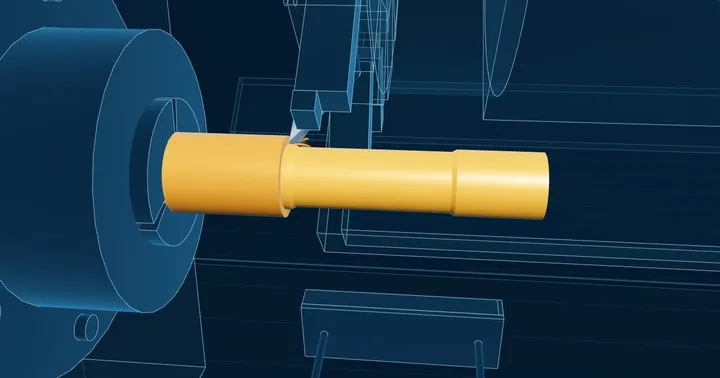
CNC turning
Studs, collars, nuts and parts from bar
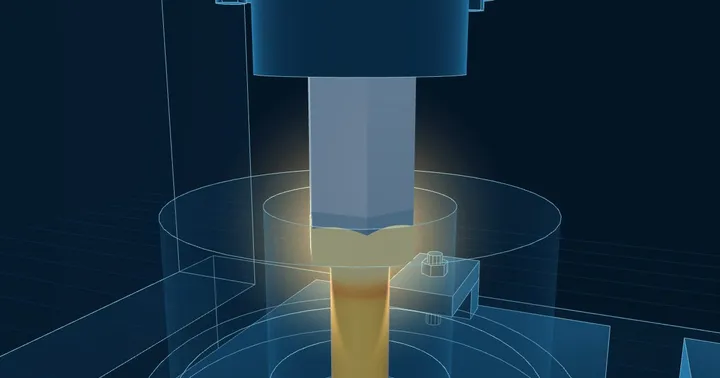
Hot forging
Bolt heads and heavy hex nuts formed from red-hot bar
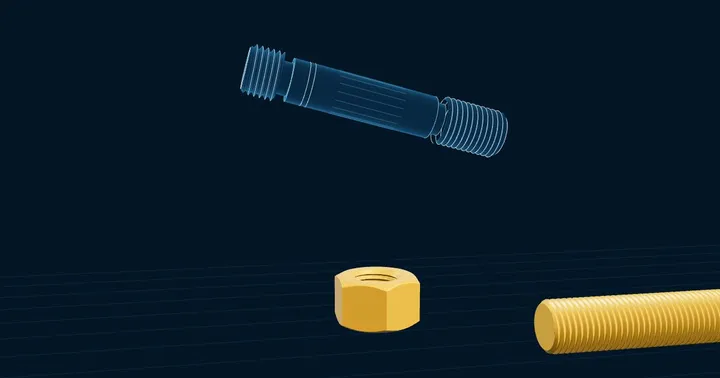
Thread gauging and dimensional inspection
Threads are checked with Go and No-Go ring and plug gauges, and pitch diameter is measured by the three-wire method or on a thread comparator. Heads, flats, lengths and radii are measured with calibrated instruments and, for complex parts, on the CMM.