

Hot forging
Hot forging heats the end of a bar until the steel flows under pressure, then drives it into a die to form a bolt head or a nut. The head is gathered from the bar itself, so the grain of the steel turns up into the head instead of being cut across.
Heat, upset, cool.
- STEP 01
Cut the blank
The bar is cut with extra length for the head, so the finished bolt meets its overall length.
- STEP 02
Heat the end
Only the length that will become the head is heated, often by induction, to forging heat: steels are forged at roughly 1700 to 2300 °F (925 to 1260 °C).
- STEP 03
Upset in the die
The bar goes into the bottom die with the hot end standing out, and a hex-shaped punch comes down into the hex recess in the die, shortening the hot end and spreading it into the head. There is no trimming step. Unsupported, no more than about three bar diameters can be gathered in one blow without buckling, so big heads take more than one.
- STEP 04
Socket heads in two blows
For socket head screws the press works two stations side by side. The first punch upsets the hot end into a round head; the part then moves to the second die, where a hex punch forms the socket in the head on the second blow. There is no trimming step.
- STEP 05
Cool, then heat treat
The forging cools and is then reheated, quenched and tempered to the grade by an outside Houston heat treater: the forging heat is not the heat treatment (ASTM A193).
- STEP 06
Thread, tap and mark
Bolts are threaded and nuts tapped. A hot-forged A194 2H nut is marked 2H; one machined from bar is marked 2HB.
- Where a forging die does not suit the size or quantity, heads and nuts are machined from bar, which the specifications also allow; ASTM A194 marks such nuts with a B.
- Strain-hardened Grade 8 nuts (ASTM A194 supplementary requirement S1) must be machined from cold-drawn bar or cold forged, with no heat treatment afterwards, so they are never hot forged.
- ASTM A574 socket head cap screws must be headed, not machined, up to 1-1/2 in.: cold headed up to 3/4 in. (and 10 diameters or 6 in. long) unless hot heading is ordered, cold or hot above that.
A forged head keeps the bar's grain in one piece.
Steel bar has a grain, like wood, running along its length. A head machined from larger bar cuts across that grain at the head-to-shank fillet; a forged head bends it up into the head. Forging that develops the grain flow improves impact toughness, fracture toughness and fatigue strength.
The specifications check the result. Upset or forged headed bolts up to 1-1/2 in., three diameters long or more, get a full-size wedge test under ASTM A193 and must not break or crack where the head meets the shank. Bolts and nuts must also pass surface inspection for discontinuities (ASTM A962 calls up F788 and F812).
For nuts the specification allows both routes. ASTM A194 lets 2H, 2HM, 7, 7M and the other heat-treated grades be hot or cold forged or machined from bar, then quenched and tempered, 2H at 850 °F (455 °C) minimum. The marking says which: 2H for a forged or punched nut, 2HB for one machined from bar.
Parts and features.
Hot forging: common questions.
How hot is the steel when it is forged?
Steels are forged at roughly 1700 to 2300 °F (925 to 1260 °C). At that heat the metal recrystallises as it deforms, so it does not work-harden.
Is the forging heat the same as heat treatment?
No. After forging, B7 and the other ferritic grades cool below the transformation range and are then reheated, liquid quenched and tempered, B7 at 1100 °F (593 °C) minimum (ASTM A193). That heat treatment is done by outside Houston processors.
What does a macroetch show?
A section through the head, polished and etched, shows the flow lines: in a forged head they bend up from the shank into the head; in a head machined from bar they run straight and stop at the surface. The same test on a cross-section shows soundness: porosity, pipe, segregation and laps.
How can I tell a forged nut from a machined one?
By the marking. ASTM A194 adds a B for nuts machined from bar stock: 2H for a hot-forged or cold-punched nut, 2HB for one machined from bar; likewise 7 and 7B, 8M and 8MB.
Before and after it.
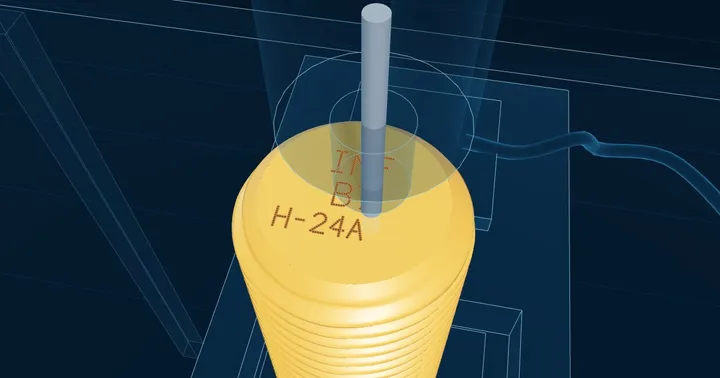
Dot-peen marking
Grade, maker and heat marked into the part, dot by dot
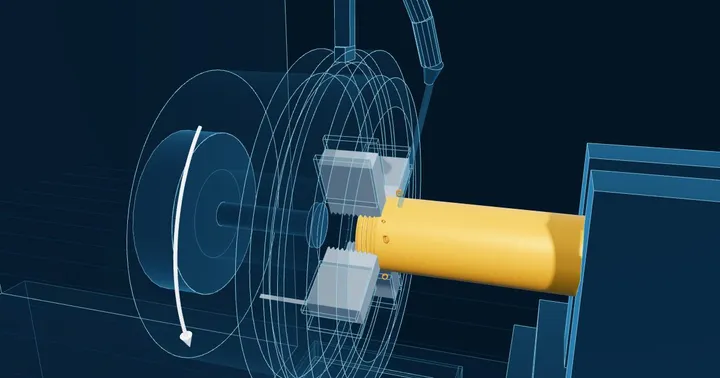
Die-head thread cutting
A ring of chasers cuts the thread in one pass, then springs open
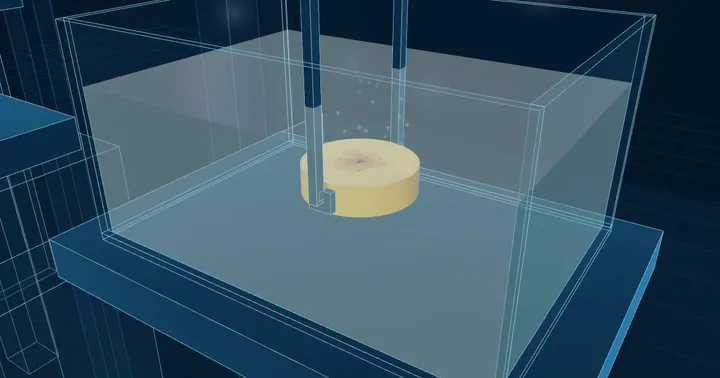
Macroetch
A slice cut from the bar or from a sample forging is etched in hot acid and examined by eye or at low magnification. It shows pipe, porosity, cracks, seams and segregation, and the flow lines left by forging. It is rated against graded standard photographs.
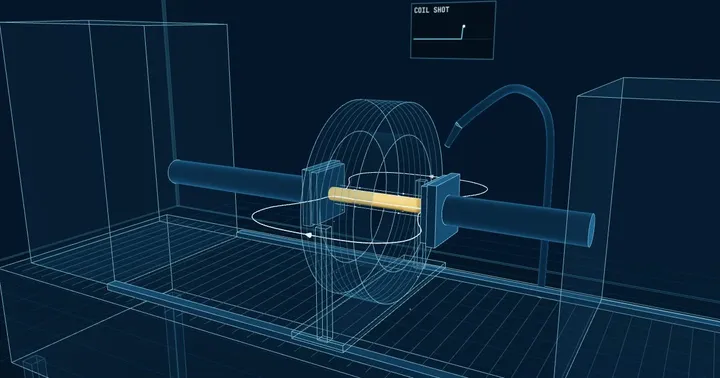
Magnetic particle inspection (MPI)
The part is magnetised and dusted with fine iron particles, dry or in a fluorescent suspension. A crack, seam or lap at or just under the surface breaks the magnetic field and the particles gather along it, showing a defect the eye cannot see.
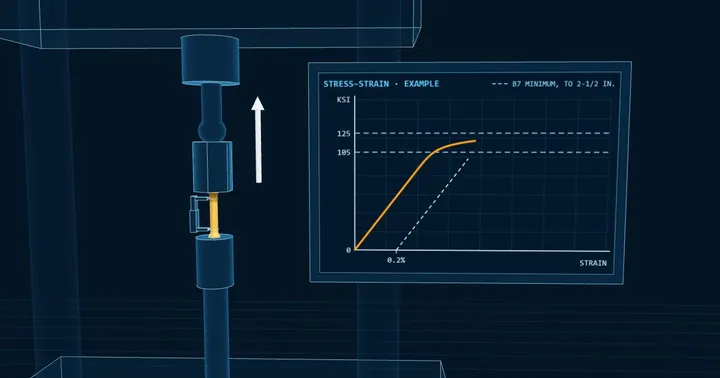
Tensile testing
The full-size fastener is pulled to failure to prove the load it carries, and a specimen machined from the lot gives tensile strength, 0.2 percent offset yield, elongation and reduction of area. All are compared with the grade's table by diameter.