

CNC turning
A CNC lathe spins the bar and moves cutting tools along and across it under program control. It is the core of our Houston shop: 27 CNC lathes turn studs, nuts, collars and machined parts from certified bar, to the standard or to your drawing.

Grip, turn, part off.
- STEP 01
Grip the bar
A bar feeder pushes the bar through the spindle to a stop, and a collet grips it. A collet wraps the whole bar and grips it on centre again after every feed; a jaw chuck takes the larger diameters.
- STEP 02
Face and turn
The end is faced square, then a turning tool feeds along the bar to cut the body: full or reduced, with collars, shoulders and points where the drawing has them.
- STEP 03
Groove and chamfer
Grooving tools cut thread reliefs and other grooves. A 45° chamfer where a thread will start keeps the threading from leaving a burr there.
- STEP 04
Thread
Threads are rolled, cut with a die head or single-pointed on the lathe; each has its own page.
- STEP 05
Part off
A parting tool cuts the finished part from the bar, and the bar feeder pushes out the next length.
- Long, slender parts bend away from the tool when they overhang a standard lathe; they go to the Swiss-type lathes, which support the bar right at the cut.
- Bolt heads can be hot forged instead of turned from bar the size of the head.
- Flats, slots and cross-holes are milled; hexes and squares can also be cut on the polygon machine.
Where the metal comes from decides what gets tested.
Studs turned from heat-treated bar carry the bar's test results, unless the finished size falls in a different band of the strength table (ASTM A962). Turn a B7 bar over 2-1/2 in. down to a 2-1/2 in. stud and the minimum tensile strength goes from 115 to 125 ksi, so the studs themselves must be tested.
Turning also takes off the outside of the bar. Where carbon or alloy steel studs are threaded on bar within 0.06 in. (1.5 mm) of the thread size, the thread is formed in the bar's own surface, and A962 asks for a decarburization test on each lot.
Nuts machined from bar are marked to say so: an A194 2H nut turned from bar is marked 2HB, a Grade 7 nut 7B. Turning in-house means odd sizes, collars and one-off drawings come from the same certified, heat-traced bar as the standard parts.
Parts and features.
CNC turning: common questions.
Collet or chuck?
A collet grips the bar all the way round, holds it concentric and grips it the same way after each feed, so it is the usual choice for bar work. A jaw chuck covers a wider range of sizes, including the large diameters.
What is a reduced-body stud?
A double-end stud whose plain body is turned to about the thread's pitch diameter instead of its full size. ASME B18.31.2 sets both: on a 1 in.-8 stud the full body is 0.983 to 1.000 in., the reduced body 0.910 to 0.983 in.
Why is a nut marked 2HB?
The B says it was machined from bar stock rather than forged (ASTM A194 Table 7). It is the same grade, made a different way.
Can the lathe cut the thread too?
Yes. Single-point threading is done on the lathe, and threads can also be rolled or cut with a die head. Each has its own page.
Before and after it.
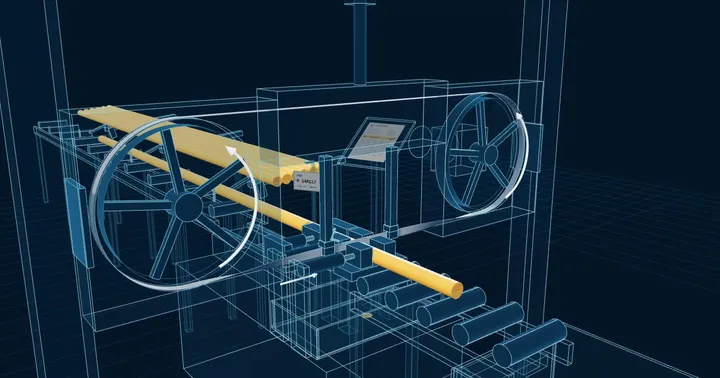
Band sawing
Certified bar cut to length, heat kept
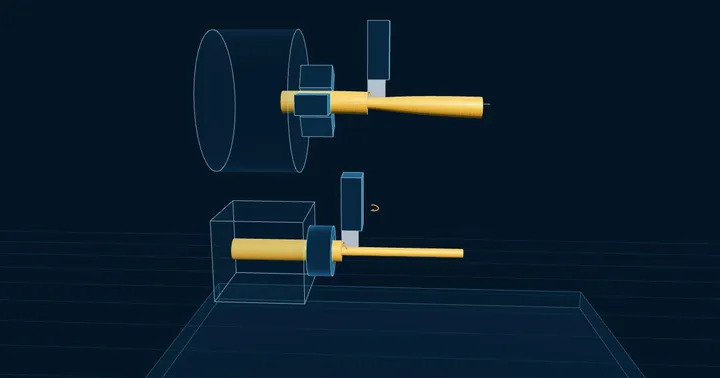
Swiss-type turning
Slender parts cut where the bar is held
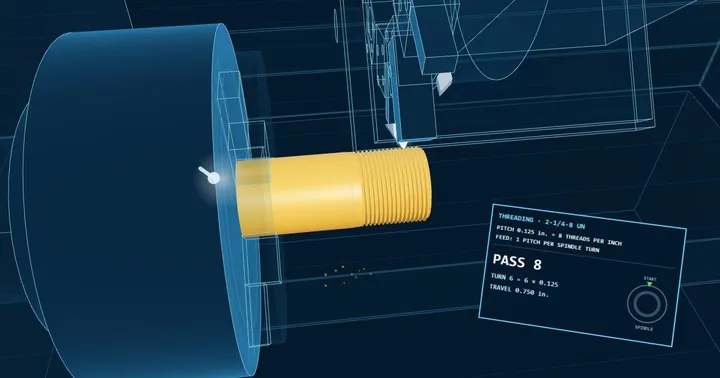
Single-point threading
One insert, many passes: any size or form on a CNC lathe
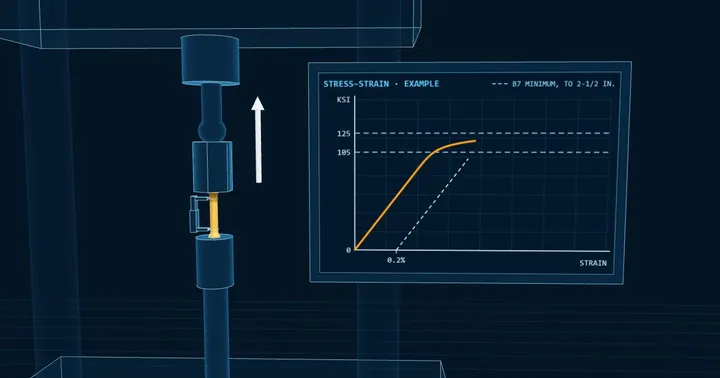
Tensile testing
The full-size fastener is pulled to failure to prove the load it carries, and a specimen machined from the lot gives tensile strength, 0.2 percent offset yield, elongation and reduction of area. All are compared with the grade's table by diameter.