

EDM sockets
Sinker EDM (electrical discharge machining) makes a hex socket without cutting. A hex-shaped electrode is lowered into the screw head under oil, and sparks jumping the small gap melt and boil away tiny craters of metal, one spark at a time but thousands every second. The electrode never touches the screw, so the screw's hardness makes no difference: the socket can be sunk after heat treatment, or in alloys that are hard on broaches.
Drill, make the electrode, spark to depth, gauge.
- STEP 01
Drill the pilot
A hole is drilled close to the size of the hex, leaving only the six corners for the sparks to erode. EDM has to remove all the metal left in the cavity, so drilling out as much as practical first saves time.
- STEP 02
Make the electrode
The electrode is a hex, usually graphite, machined a little smaller than the socket. Sparks need a gap all round it, so the socket always comes out larger than the electrode by that gap, the overcut, and the electrode is made undersize to suit the power settings.
- STEP 03
Set up under oil
The screw is clamped head-up on the machine table, the electrode is fixed in a holder on the ram above it, and the tank fills with dielectric oil until the head is well covered. The oil insulates the gap until each spark, cools the cut and carries the debris to a filter.
- STEP 04
Spark to depth
A servo lowers the electrode until the first spark, then holds the gap while the metal melts away in tiny craters, feeding down to a set depth in a single pass. The electrode jumps up at intervals to pump fresh oil through the gap.
- STEP 05
Gauge the socket
A GO hex gauge must enter to the minimum key engagement in ASME B18.3, and the NOT GO gauge must not enter across the flats, the same check as for a broached socket. Electrode corners wear fastest and round off the socket's corners, so a worn electrode is cut back or replaced.
- It is slow. Metal comes away one spark at a time, at rates counted in cubic inches per hour, so the sockets of standard screws made in quantity are forged or broached instead.
- It leaves a heat-affected skin. Every EDM surface has a thin re-frozen layer, hard and brittle and able to hold fine cracks, over a zone that was heated but not melted, both deeper at higher spark energy. Published tests have found EDM'd surfaces weaker in fatigue, from slightly to markedly, unless the layer is removed.
- Electrodes wear. Corners go first, so a worn electrode is cut back or replaced, and an electrode has to be made for each socket size.
- Some aerospace purchase terms forbid EDM unless the drawing, specification or contract calls for it or the buyer approves it in writing, and space fracture-control rules require its effect on fatigue to be verified. Check the drawing and the order first.
A spark doesn't care how hard the screw is.
A broach has to cut the metal, and its life falls away as the work gets harder; a common rule of thumb puts the limit near 35 HRC. A finished ASTM A574 socket head cap screw is 37 to 44 HRC and an F912 set screw 45 to 53 HRC, which is why broached sockets are made before heat treatment. A spark only needs metal that conducts, so EDM can make or enlarge a socket in a screw that is already hardened.
Tough, age-hardened alloys are the same story. Alloy 718 bar to ASTM B637 is at least 331 HB after aging, A286 bolting to A453 Grade 660 runs up to about 37 HRC, and titanium and nickel alloys call for premium broach steels and coatings. To a spark they are simply conductive metal, cut with the electrode polarity chosen to suit each one: titanium, for one, is cut with the electrode negative.
Nothing is left in the hole. A broach packs its chips into the pilot below the socket, and federal specification FF-S-86 requires loose broaching chips to be removed. EDM debris leaves as fine particles in the oil and the electrode never touches the screw, so there is no packed chip and no cutting burr. With EDM, large sockets (up to 3 in. across flats on a 4 in. screw) and one-off sizes need no broach at all: the electrode is a plain graphite hex, cut back and reused when its end wears.
Parts and features.
EDM sockets: common questions.
Does ASTM A574 allow an EDM'd socket?
A574 lets the maker forge or machine the socket and does not name a machining method, so EDM is neither listed nor ruled out. The socket must still pass the ASME B18.3 gauges and A574's limits on cracks and other discontinuities in the socket. A drawing or purchase order can still forbid EDM, and some aerospace terms do.
What is the recast layer?
Metal that melted in a spark crater and froze again in the oil instead of being flushed away. It is hard and brittle and can hold fine cracks, and under it lies a zone that was heated but not melted. Both get deeper as the spark energy goes up, and polishing or abrasive flow can remove them; where fatigue matters, the drawing can limit the layer or call for its removal.
Why is the electrode smaller than the socket?
The sparks need a gap all round the electrode, so the socket always comes out larger by that gap, the overcut. It runs from about 0.0008 in. (0.020 mm) a side at the lowest settings to 0.025 in. (0.63 mm) at the highest, so the electrode is made undersize to suit the settings and the socket comes out to size in one pass.
Before and after it.
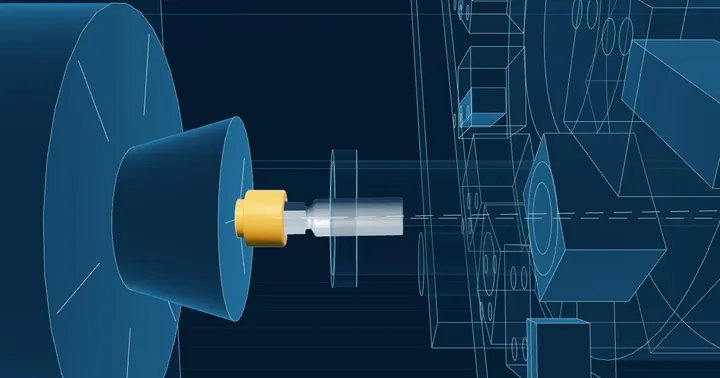
Socket broaching
Hex sockets in cap screws and set screws
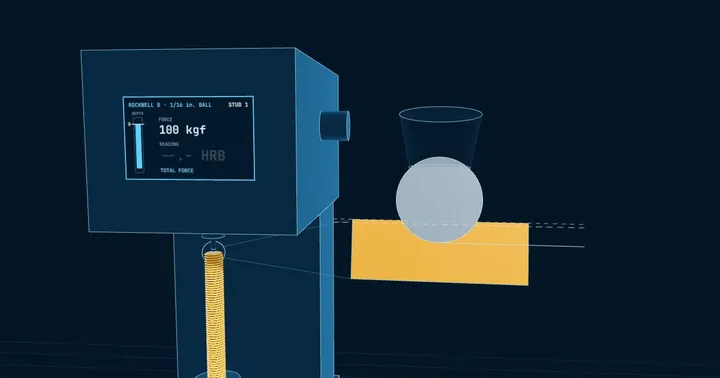
Hardness testing
A Rockwell or Brinell indenter is pressed into the part and the indentation measured. Hardness tracks the heat treatment, so it catches an under-tempered lot, and sour-service grades carry a hardness ceiling that every piece must meet.
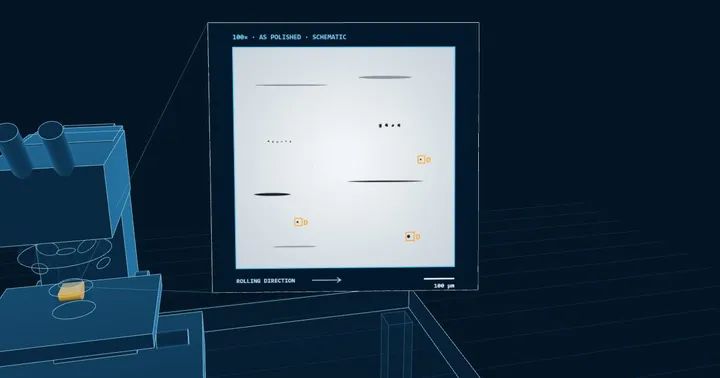
Metallography: inclusions and grain size
A polished section is examined under the microscope. Non-metallic inclusions are rated by type (sulfide, alumina, silicate and globular oxide) and by thickness. The grain size is measured as an ASTM grain size number, where a higher number means finer grains.