

Swiss-type turning
On a Swiss-type lathe the headstock slides: it pushes the turning bar out through a guide bushing, and the tools cut right at the face of the bushing, where the bar is supported. That makes it the machine for long, slender, precise parts such as set screws, small studs and pins.

The bar moves. The tool stays at the bushing.
- STEP 01
Ground bar in
The bar runs through the collet in the sliding headstock and into the guide bushing. Ground bar, straight and close to size, is used so it can slide through the bushing as it turns.
- STEP 02
Cut at the bushing face
The tools sit side by side in a gang just in front of the bushing and move across the bar. The headstock moves the turning bar along its axis, so the profile is cut as the bar comes out.
- STEP 03
Points and details
Cup, flat, oval, cone and dog points, grooves and chamfers are cut the same way, always close to the support.
- STEP 04
Part off and finish the back
The subspindle grips the end of the part and it is cut off at the bushing face. The subspindle carries it to the back tool gang, which works its back end while the next part starts, then ejects it onto a parts conveyor.
- Larger diameters are turned on the shop's other CNC lathes; the Swiss-type lathes run small bar.
- Short, thick parts gain little from the guide bushing and are turned on a standard CNC lathe.
- Bar that is not straight and close to size is not run through a guide bushing; some Swiss-type machines can run without one, like a standard lathe, for short parts.
Support at the cut is what holds the size.
A slender part with a long overhang bends away from the tool, and its diameter and straightness wander. On a Swiss-type lathe the cut is always next to the bushing that holds the bar, so the unsupported length stays short however long the part is.
Socket set screws suit it. ASTM F912 (alloy) and F880 (stainless) allow set screws to be machined, and ASME B18.3 sets the point on the end, cup, flat, oval, cone or half dog, for every size. The hex socket in the other end is broached.
Running Swiss-type lathes in-house means small specials in stainless and nickel alloys come from the same certified bar as everything else, in the quantity the job needs.
Parts and features.
Swiss-type turning: common questions.
What makes a lathe Swiss-type?
The headstock slides along the bed and pushes the bar through a guide bushing, and the tools cut at the bushing face. On a standard lathe the bar stays put in the chuck and the tool travels along it.
Why ground bar?
The bar slides through the guide bushing while it is cut, so it must be straight and close to size, which ground bar is. Machines that can run without the bushing take ordinary bar for short parts.
Which parts suit Swiss-type turning?
Parts that are long for their diameter: set screws, pins, small studs and slender machined parts. Short, thick parts go to a standard CNC lathe.
Before and after it.
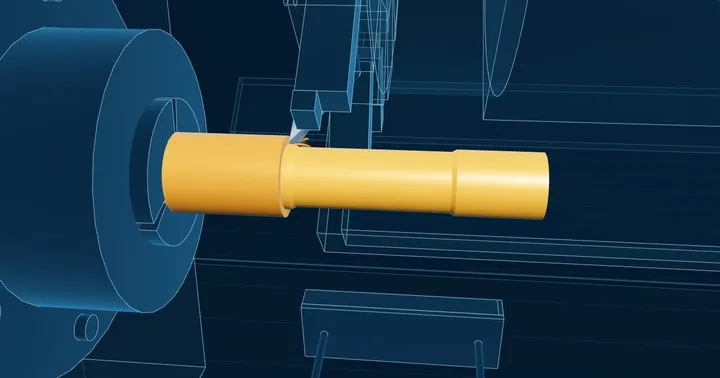
CNC turning
Studs, collars, nuts and parts from bar
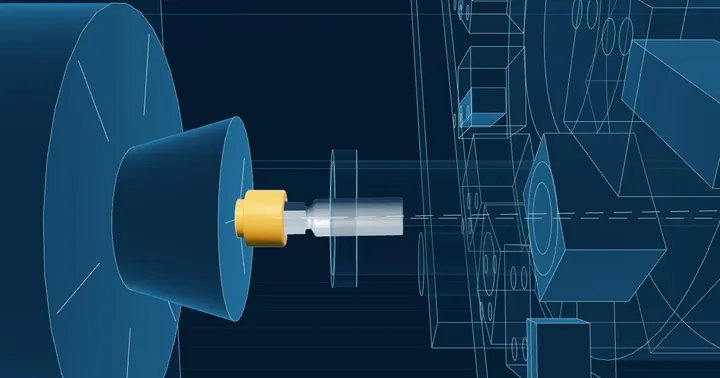
Socket broaching
Hex sockets in cap screws and set screws
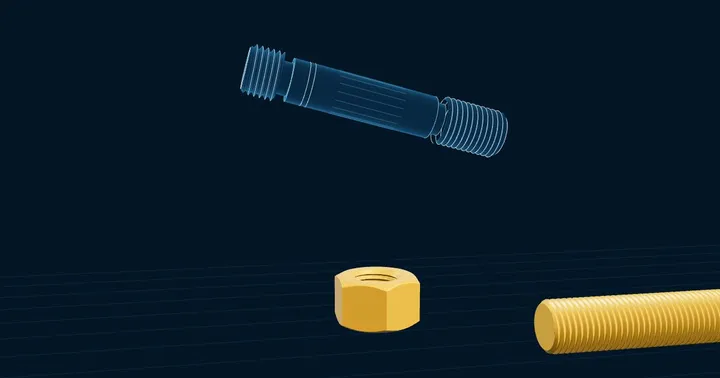
Thread gauging and dimensional inspection
Threads are checked with Go and No-Go ring and plug gauges, and pitch diameter is measured by the three-wire method or on a thread comparator. Heads, flats, lengths and radii are measured with calibrated instruments and, for complex parts, on the CMM.