

Elevated-temperature tensile testing
Bolting alloys lose strength as they get hotter. An elevated-temperature tensile test heats a machined specimen in a furnace, holds it at the test temperature and pulls it to failure, giving tensile strength, yield strength, elongation and reduction of area at temperature.
Heat it, hold it, pull it.
- STEP 01
Machine the specimen
A round specimen with threaded ends, such as the standard 0.500 in. diameter, 2 in. gauge specimen, is machined from the bar or bolt.
- STEP 02
Heat and hold
A furnace brings it to the test temperature, read by thermocouples, and holds it there within ±5 °F (±3 °C) up to 1800 °F (980 °C), or ±10 °F (±6 °C) above.
- STEP 03
Pull slowly through yield
An extensometer measures the stretch while the specimen is strained at 0.005 per minute (±0.002) until the 0.2% offset yield strength is found.
- STEP 04
Pull to failure
The rate steps up to 0.05 per minute (±0.01) and the specimen is pulled until it breaks; the peak load gives the tensile strength at temperature.
- STEP 05
Measure the pieces
Once cool, the halves are fitted together to measure elongation and reduction of area, as in a room-temperature test.
- It is a short test. It shows strength at temperature, not how long a bolt will carry its load there; stress-rupture and creep tests measure that (ASTM E139).
- ASTM E21 is a method: the minimum values must come from the material specification or the order.
- It does not measure the slow loss of clamp load at temperature, stress relaxation, which has its own test (ASTM E328).
Room-temperature figures do not hold when it is hot.
Bolting is normally certified on room-temperature tests. ISO 898-1, for example, specifies its property classes at 10 to 35 °C and warns that they might not hold at higher temperatures. In a hot joint, the strength that counts is the strength at service temperature.
The drop can be large. Alloy 718 bolting to ASTM A1014 needs 185 ksi tensile and 150 ksi yield at room temperature, but 145 ksi and 125 ksi at 1200 °F (650 °C). ASTM F2281 tabulates hot minimums for its high-temperature alloys: A-286 (Grade 660) falls from 104 ksi tensile at 1200 °F to 36.5 ksi at 1500 °F.
ASTM A1014 is one specification that requires the test, with 1200 °F minimums for alloy 718 bolting. ASTM A193 (supplementary requirement S1) and F2281 (S8) make high-temperature tests available when the order asks for them, F2281 against its table of hot minimums. ASTM A453 and B637 use stress-rupture tests instead, and A437 relies on chemistry, heat treatment and room-temperature properties.
Grades and specifications.
What the report shows.
- The test temperature.
- Tensile strength and 0.2% offset yield strength at temperature.
- Elongation and reduction of area.
- Specimen size and the lot it represents.
How to ask for it.
- Give the test temperature and the minimum values, or name the specification or supplementary requirement that sets them, such as ASTM A1014 or F2281 S8.
- If what matters is how long the bolts will last at temperature, ask for stress-rupture testing.
Elevated-temperature tensile testing: common questions.
Is a hot tensile test the same as a creep test?
No. A tensile test at temperature takes minutes. Creep and stress-rupture tests hold a constant load at temperature for hours or more, and measure the stretch over time or the time to break (ASTM E139).
Does A193 B16 need elevated-temperature tests?
Not unless they are ordered. ASTM A193 offers high-temperature tests as supplementary requirement S1, and stress-rupture testing of B16 as S12.
How closely is the temperature held?
Within ±5 °F (±3 °C) up to 1800 °F (980 °C), and ±10 °F (±6 °C) above (ASTM E21).
What strain rate is used?
0.005 per minute (±0.002) until the yield strength is found, then 0.05 per minute (±0.01) to failure (ASTM E21).
Often ordered with it.
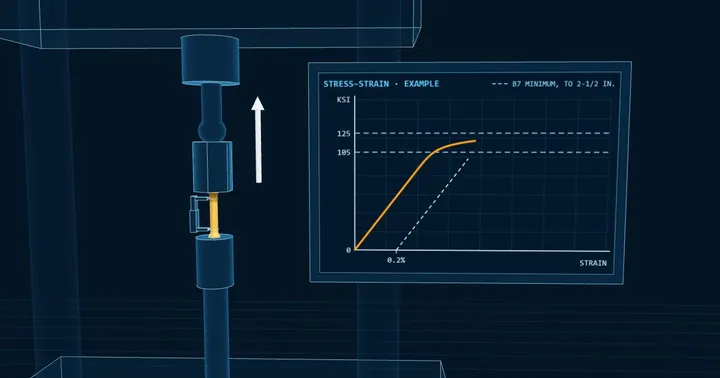
Tensile testing
The full-size fastener is pulled to failure to prove the load it carries, and a specimen machined from the lot gives tensile strength, 0.2 percent offset yield, elongation and reduction of area. All are compared with the grade's table by diameter.
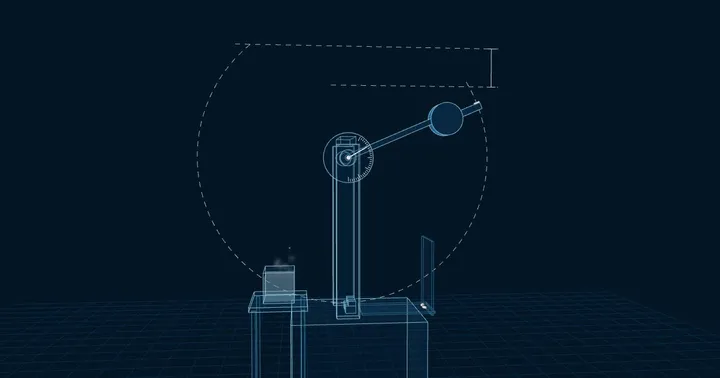
Charpy V-notch impact testing
A notched specimen machined from the lot is chilled to the test temperature and struck by a swinging hammer; the energy it absorbs before breaking is the result. Low-temperature grades must absorb a minimum energy at temperature, which is the difference between a B7 and an L7.
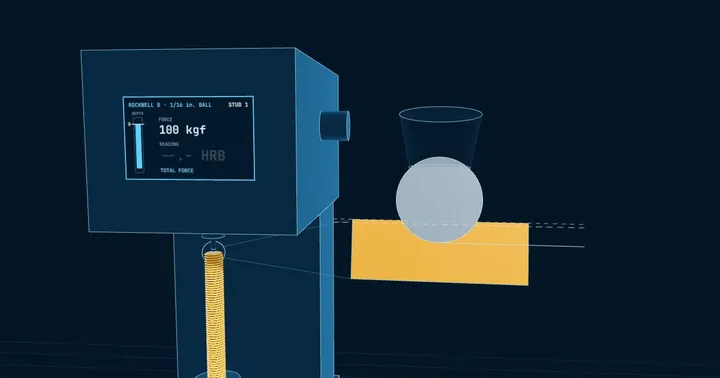
Hardness testing
A Rockwell or Brinell indenter is pressed into the part and the indentation measured. Hardness tracks the heat treatment, so it catches an under-tempered lot, and sour-service grades carry a hardness ceiling that every piece must meet.