

Tensile testing
Pulling a sample to destruction shows whether the material is as strong as its specification says: its tensile strength, yield strength, elongation and reduction of area.
Pulled until it breaks.
- STEP 01
Choose the specimen
The whole fastener is pulled in a fixture to prove the load it carries, or a round specimen is machined from it: the standard 0.500 in. specimen with a 2 in. gauge length, from the centre of bolts under 1-1/2 in. and halfway out on larger ones.
- STEP 02
Grip it
The ends are held in threaded or wedge grips, lined up so the pull is straight along the axis.
- STEP 03
Measure the stretch
An extensometer clipped to the gauge length measures stretch as the load rises, which gives the yield strength by the 0.2% offset method.
- STEP 04
Pull to failure
The load climbs to a peak, the tensile strength, then the specimen necks down and breaks.
- STEP 05
Measure the pieces
The broken halves are fitted back together to measure elongation over the gauge length and the reduction of area at the break.
- A full-size pull gives the load the fastener carries, and its yield by the offset method, but elongation and reduction of area need a machined specimen.
- On very large bolting the core can be weaker than the reported figures, because the specimen comes from halfway out, not the centre.
Strength is what a bolt is bought for, and it falls with size.
Quenched-and-tempered bolting does not harden right through a thick section, so the strength tables step down as the diameter goes up. ASTM A193 B7 needs 125 ksi tensile and 105 ksi yield up to 2-1/2 in., 115 and 95 ksi over 2-1/2 to 4 in., and 100 and 75 ksi over 4 to 7 in.
For studs and bolts, A193 calls for one tension test per diameter per heat in each lot. Upset or forged headed bolts up to 1-1/2 in. and at least three diameters long also get a full-size wedge test, which must not break or crack at the junction of head and shank.
Strain-hardened Class 2 stainless bolting (B8, B8M) gets its strength from cold work, so it is tested full size after strain hardening.
Grades and specifications.
What the report shows.
- Tensile strength and yield strength.
- Elongation and reduction of area (machined specimens).
- Specimen type and size, and the heat and lot it represents.
How to ask for it.
- Name the grade and size; the test and the strength it must meet come with the specification.
- Ask for full-size testing if your specification or customer requires it.
Tensile testing: common questions.
Full-size or machined specimen?
A full-size pull proves the fastener itself, threads and all, but gives only the load it carries and its yield by the offset method. Elongation and reduction of area need a machined specimen.
Why does the required strength drop for bigger studs?
A thick section does not harden right through when it is quenched, so the specification sets lower minimums for larger diameters. B7 goes from 125 ksi tensile up to 2-1/2 in. to 100 ksi over 4 in.
What is a wedge test?
A headed bolt is pulled with a hardened wedge under its head, 10° on bolts up to 1 in. and 6° above (less on bolts threaded close to the head), so the head is bent as it loads. It must not break where the head meets the shank (ASTM A370, F606).
How many are tested?
For A193 studs and bolts, one tension test per diameter per heat in each lot. A lot is up to 1500 lb for sizes to 1-1/8 in., more for larger sizes, and 100 pieces over 2-1/2 in.
Often ordered with it.
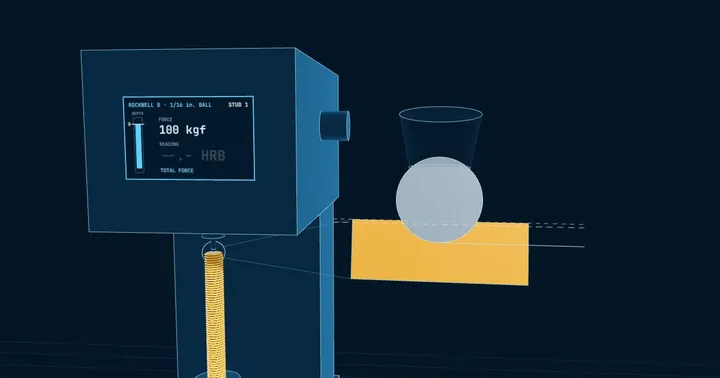
Hardness testing
A Rockwell or Brinell indenter is pressed into the part and the indentation measured. Hardness tracks the heat treatment, so it catches an under-tempered lot, and sour-service grades carry a hardness ceiling that every piece must meet.
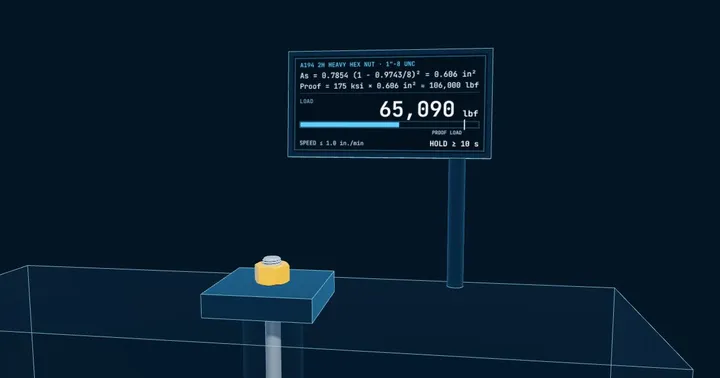
Proof load testing of nuts
The nut is threaded on a hardened mandrel and loaded to the proof stress for its grade and size. It passes if the threads neither strip nor break and it can be removed by hand afterwards; a wrench may start it, for up to half a turn.
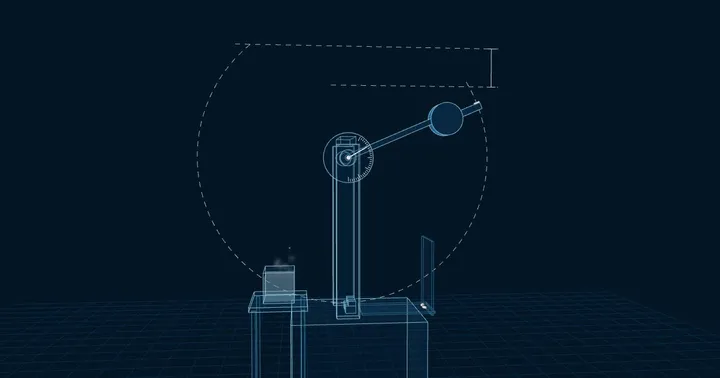
Charpy V-notch impact testing
A notched specimen machined from the lot is chilled to the test temperature and struck by a swinging hammer; the energy it absorbs before breaking is the result. Low-temperature grades must absorb a minimum energy at temperature, which is the difference between a B7 and an L7.