

Hydrogen embrittlement relief and testing
High-strength steel can take in hydrogen while it is acid-cleaned and electroplated, then crack days later under load. Baking soon after plating drives the hydrogen out, and a sustained-load test on parts from the lot proves it worked.
Plate, bake, prove.
- STEP 01
Clean and plate
Acid cleaning and electroplating release hydrogen at the steel surface, and some of it diffuses into the steel.
- STEP 02
Bake
Parts with a specified hardness over 39 HRC are baked at 375 to 425 °F: at least 14 hours up to 44 HRC, 24 hours above. It is done as soon as possible after plating, before the chromate (ASTM F1941).
- STEP 03
Hold under load
Fasteners from the lot are tightened against a wedge to 75% of their minimum tensile strength and held for at least 48 hours (ASTM F606).
- STEP 04
Check
Under at least 20× magnification there must be no cracks and no missing heads, and the torque to retighten must still be 90% of the original.
- Baking reduces the risk; it cannot fully remove it. ASTM F1941 does not recommend electroplating case-hardened fasteners or fasteners harder than 39 HRC at all.
Harder steel, higher risk.
The harder the steel, the less hydrogen it takes to crack it. ASTM F1941 makes baking mandatory where the specified hardness is over 39 HRC. Alloy socket head cap screws (ASTM A574) are 39 to 44 HRC up to 1/2 in. and 37 to 44 HRC above, so plating them calls for the bake; their standard black oxide finish needs no embrittlement testing.
B7 studs and 2H nuts, at 35 HRC maximum, are below that line, so baking is not mandatory for them under F1941.
Plating shops can also prove the process itself on notched test bars (ASTM F1940 or F519). Under F1941, where F1940 process control passes at least monthly, baking and product testing are not mandatory.
Grades and specifications.
What the report shows.
- The bake: temperature and time.
- The sustained-load test result, when ordered.
How to ask for it.
- Name the coating specification (for zinc on fasteners, ASTM F1941) and the part's hardness; the bake follows from them.
- Ask for the ASTM F606 sustained-load test if you want proof on the lot.
Hydrogen embrittlement relief and testing: common questions.
Do B7 studs need a hydrogen bake after zinc plating?
Not under ASTM F1941, which makes baking mandatory only where the specified hardness is over 39 HRC; B7 is 35 HRC maximum. If you want one anyway, say so on the order.
How soon after plating must parts be baked?
As soon as possible, before the chromate (ASTM F1941). ASTM B633 asks for baking within 4 hours of plating.
What is the difference between F606 and F519 testing?
The ASTM F606 test loads the actual fasteners from the lot for 48 hours. F519 and F1940 load standard notched bars plated with the work, to prove the plating process does not embrittle steel.
Often ordered with it.
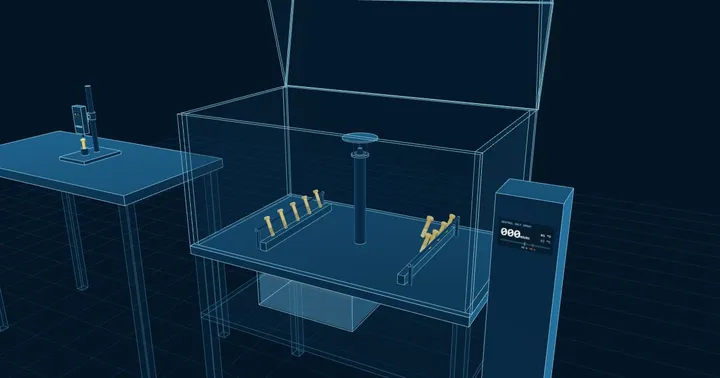
Coating thickness and salt spray
Coating thickness is measured with a magnetic or eddy-current gauge, or by X-ray fluorescence for thin platings, and checked against the class ordered. Salt-spray exposure checks corrosion protection on a sample from the lot when the specification calls for it.
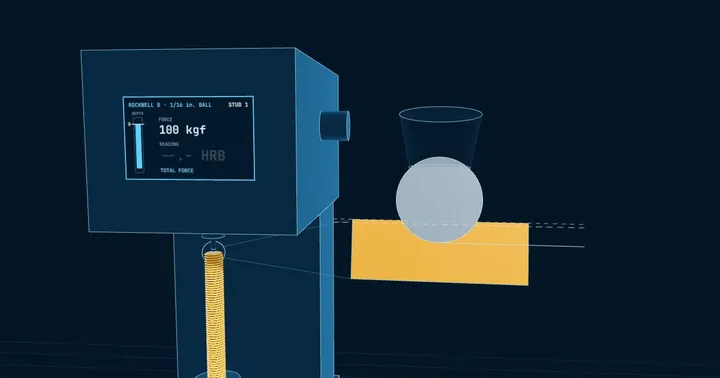
Hardness testing
A Rockwell or Brinell indenter is pressed into the part and the indentation measured. Hardness tracks the heat treatment, so it catches an under-tempered lot, and sour-service grades carry a hardness ceiling that every piece must meet.
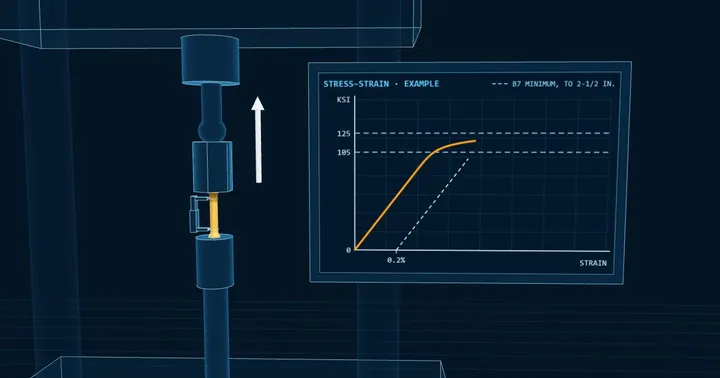
Tensile testing
The full-size fastener is pulled to failure to prove the load it carries, and a specimen machined from the lot gives tensile strength, 0.2 percent offset yield, elongation and reduction of area. All are compared with the grade's table by diameter.