

Intergranular corrosion testing
Austenitic stainless held in the wrong temperature range forms chromium carbides along its grain boundaries, and the metal beside them loses chromium. A corrosive liquid can then attack along the grain boundaries. ASTM A262 tests stainless steel for this susceptibility; ASTM G28 does the same for nickel alloys.
Screen, expose, bend or weigh.
- STEP 01
Screen (Practice A)
A polished sample is etched in oxalic acid and its structure classified. An acceptable structure clears the material without further testing; a suspect one goes on to an acid exposure test.
- STEP 02
Sensitize, when specified
Low-carbon and stabilized grades such as 304L, 316L, 321 and 347 are given a sensitizing heat treatment before the test when the specification calls for it.
- STEP 03
Practice E
The sample is exposed to a copper–copper sulfate–16% sulfuric acid solution, then bent and examined: acceptable or not.
- STEP 04
Weight-loss practices
Practices B (ferric sulfate–sulfuric acid), C (nitric acid) and F (copper–copper sulfate–50% sulfuric acid, for molybdenum-bearing grades) report a corrosion rate from the weight lost.
- STEP 05
Nickel alloys (ASTM G28)
Method A boils the alloy in ferric sulfate–50% sulfuric acid: 120 hours for 625, 24 hours for C-276. Method B uses a mixed acid and oxidizing-salt solution and shows a step rise in corrosion rate when grain-boundary precipitation is heavy.
- These tests show susceptibility to intergranular attack. They do not predict pitting, general corrosion or stress-corrosion cracking (ASTM A262), or service performance (ASTM G28).
- Practice A only screens: it can accept a sample but not reject it.
- G28 sets no pass or fail limit; the acceptable corrosion rate is agreed between buyer and supplier. It is for wrought alloys, not castings.
Attack along the boundaries, not across the surface.
Austenitic stainless sensitizes when it spends time between about 950 and 1450 °F, as in welding, stress relief or hot forming. Solution annealing dissolves the carbides and fast cooling stops them returning. That is why A193 Class 1A bolting is solution treated in the finished condition, for corrosion resistance.
Low-carbon L grades resist sensitization during welding, but not long exposure in that range. Stabilized grades such as 321 and 347 tie up the carbon with titanium or niobium. Stainless bar and fastener specifications (A484, F593, F594, F837) require material capable of passing Practice E, but run the test only when it is ordered. The exception is hot-worked F593 and F837 parts, which are tested once per lot.
A193, A194, A320 and A962 have no intergranular corrosion requirement, so bolting buyers who need the test put it on the order and name the practice. A182 supplementary requirement S4 makes Practice E mandatory for austenitic forgings when it is specified.
Grades and specifications.
What the report shows.
- The practice or method used: A262 A, B, C, E or F, or G28 A or B.
- Acceptable or suspect for Practice A, and acceptable or not for Practice E.
- A corrosion rate for Practices B, C and F and for G28.
How to ask for it.
- Name the practice: for stainless, ASTM A262 Practice E (Practice A may screen); for nickel alloys, ASTM G28 Method A or B with the acceptable corrosion rate.
- For L and stabilized grades, say whether the specimens are to be sensitized before the test.
- For bolting to A193, A194 or A320, put the test on the order: those specifications do not include it.
Intergranular corrosion testing: common questions.
What is sensitization?
Chromium carbides forming along the grain boundaries of austenitic stainless held between about 950 and 1450 °F. The narrow zone beside them loses chromium and corrodes first.
Does an L grade still need the test?
L grades resist sensitization during welding but not long exposure in that range. Some specifications, such as A479, test L and stabilized grades on sensitized specimens.
Why is Practice A only a screen?
It is a rapid etch that clears material essentially free of susceptibility. It can only class a sample as acceptable or suspect, so a suspect result needs an acid exposure practice.
Is G28 the same as A262?
No. A262 is for austenitic stainless steels. G28 is for wrought nickel-rich, chromium-bearing alloys such as 625 and C-276, with its own solutions and test times.
Often ordered with it.
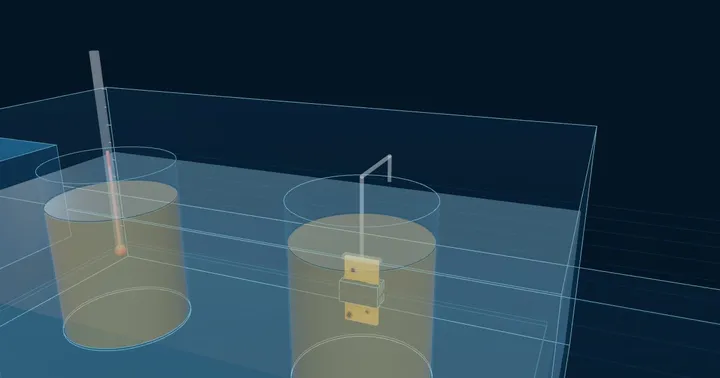
Pitting corrosion testing
Samples are exposed to ferric chloride solution to rank their resistance to pitting and crevice corrosion, or tested at a series of temperatures to find the critical pitting temperature. It is used on duplex, super duplex, 6% molybdenum austenitic grades and nickel alloys, and it shows whether the material lives up to its PREN.
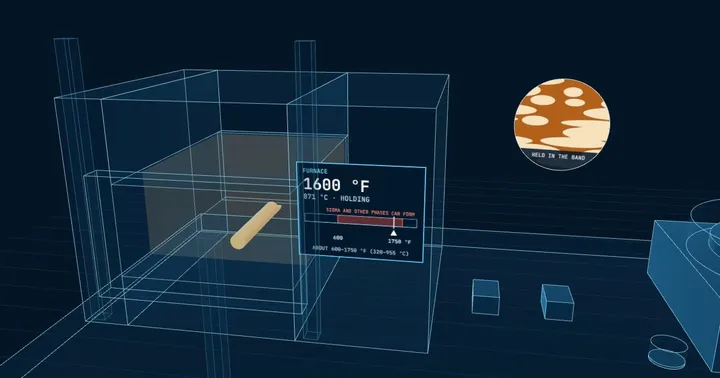
Ferrite content and phase balance
A polished section of duplex stainless is point-counted to measure how much of it is ferrite. ASTM A923 shows whether harmful intermetallic phases such as sigma are present, by an etch screen, a Charpy test or a ferric chloride corrosion test. For austenitic parts that must be non-magnetic, relative magnetic permeability is measured instead.
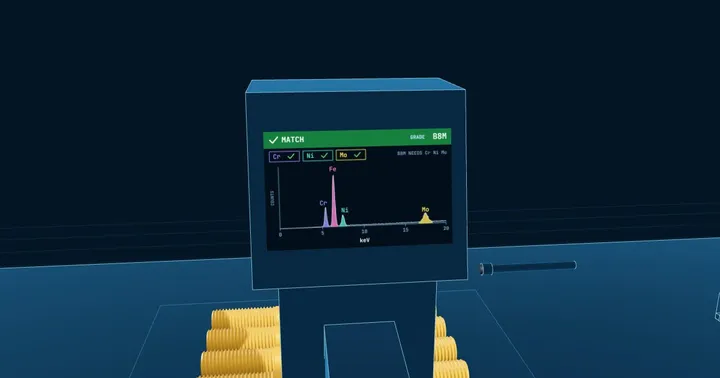
Positive Material Identification (PMI)
A handheld X-ray fluorescence analyser reads the chemistry of the finished part in seconds and matches it to the grade. It confirms that a B7 is chromium-molybdenum steel and not plain carbon, that a B8M has its molybdenum, and that a nickel-alloy stud is the alloy on the certificate. Handheld XRF does not read carbon, so carbon is confirmed from the mill certificate or by spark (OES) analysis.