

Pitting corrosion testing
In chloride service such as seawater, stainless steels and nickel alloys can suffer pitting and crevice corrosion. ASTM G48 exposes samples to ferric chloride solution to rank their resistance, and its critical-temperature methods find the temperature at which pitting starts. The higher that temperature, the better.
Prepare, immerse, inspect, rank.
- STEP 01
Prepare the coupons
Coupons are cut and their surfaces prepared the same way every time, because surface preparation can change the result significantly (ASTM G48).
- STEP 02
Pitting test (Method A)
The coupon is immersed in ferric chloride solution at a set temperature for a set time, then examined for pitting against the criterion on the order.
- STEP 03
Crevice test (Method B)
Method B tests resistance to crevice corrosion as well as pitting.
- STEP 04
Critical temperatures (Methods C to F)
Methods C and D (nickel alloys) and E and F (stainless steels) find the critical pitting or crevice temperature: the lowest temperature at which attack starts.
- STEP 05
Duplex acceptance (ASTM A923 Method C)
For duplex there is a 24-hour ferric chloride test with a set limit of 10 mg/dm² per day. It runs at 77 °F (25 °C) for 2205 and 104 °F (40 °C) for 2507-type super duplex.
- G48 ranks alloys under its own test conditions. It does not predict service life, how fast pits grow, or behaviour outside chloride environments.
- G48 has no acceptance criteria of its own. The method, temperature, time, surface preparation, whether edge attack counts, and the acceptance criterion must all be specified.
- PREN ranks grades within one family and assumes correctly processed material; it says nothing about intermetallic phases or poor heat treatment.
Chemistry sets the potential; processing decides whether you get it.
Pitting resistance rises with chromium, molybdenum, tungsten and nitrogen, summed as the pitting resistance equivalent number: PREN = Cr + 3.3(Mo + 0.5W) + 16N, in weight percent. Super duplex grades, with about 25% chromium and 3% molybdenum, reach PREN 40 to 45.
Some specifications set a minimum, and they do not all use the same formula. ASTM A1082 requires 40 for S32760 bolting, counting chromium, molybdenum and nitrogen only. A479 bar and A182 forgings in the same alloy must reach 41, with half the tungsten added to the molybdenum.
A high PREN is not proof of a good part. Intermetallic phase from wrong heat treatment can lower the critical pitting temperature by 27 °F (15 °C) or more, and a weld's can be 9 to 27 °F (5 to 15 °C) below the base metal's. A corrosion test on the actual material shows what the formula cannot.
Grades and specifications.
What the report shows.
- The G48 method, temperature and duration, or the A923 method.
- Whether pitting was found, and the weight loss or corrosion rate where one is specified.
- For the critical-temperature methods, the CPT or CCT.
How to ask for it.
- Specify it all: the G48 method, temperature, duration, surface preparation, whether edge attack counts, and the acceptance criterion. G48 itself sets none.
- For duplex and super duplex, ASTM A923 Method C is a ready-made acceptance test with its own temperatures and corrosion-rate limit.
- If your specification sets a minimum PREN, give the formula with it: A1082 and A479 calculate it differently for S32760.
Pitting corrosion testing: common questions.
What formula is used for PREN?
Commonly Cr + 3.3(Mo + 0.5W) + 16N, in weight percent. Some investigators use 22 or 30 for nitrogen, and some specifications leave tungsten out, so quote the formula with the number.
Does passing G48 guarantee service performance?
No. It is an accelerated laboratory test that ranks alloys. Ferric chloride is related to, but not the same as, the liquid inside a pit or crevice in service.
What is the critical pitting temperature?
The temperature above which pitting starts and grows to a visible size within about 24 hours in a given chloride environment; below it, pits do not start. The critical crevice temperature is typically 27 to 36 °F (15 to 20 °C) lower.
Why test duplex to A923 rather than plain G48?
A923 Method C is written as an acceptance test for harmful intermetallic phases, with set temperatures and a 10 mg/dm² per day limit. G48 is a laboratory procedure whose variables must all be specified.
Often ordered with it.
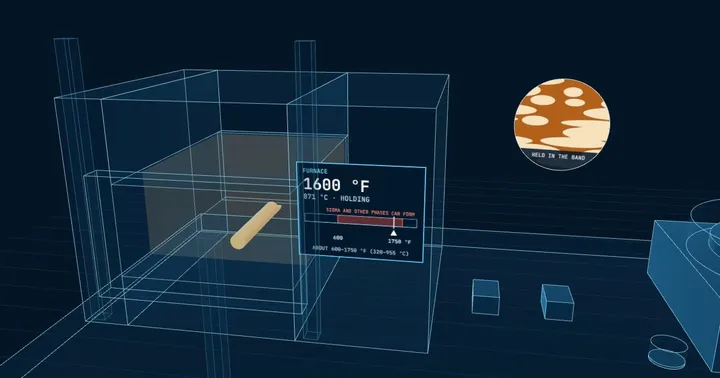
Ferrite content and phase balance
A polished section of duplex stainless is point-counted to measure how much of it is ferrite. ASTM A923 shows whether harmful intermetallic phases such as sigma are present, by an etch screen, a Charpy test or a ferric chloride corrosion test. For austenitic parts that must be non-magnetic, relative magnetic permeability is measured instead.
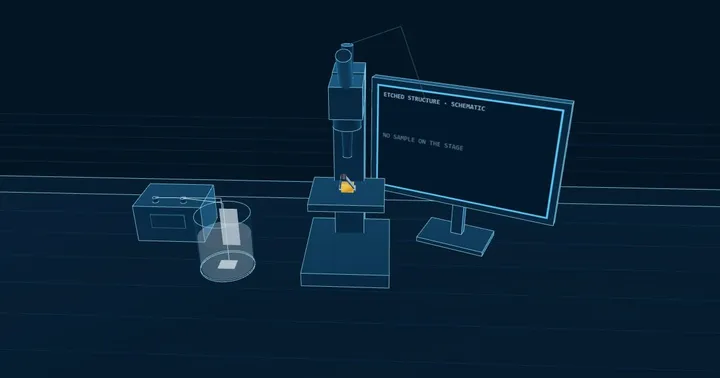
Intergranular corrosion testing
Austenitic stainless that has formed chromium carbides along its grain boundaries can corrode along them. ASTM A262 screens with an oxalic acid etch (Practice A) and tests with acid exposures. Stainless bar and fastener specifications name Practice E: a copper–copper sulfate–sulfuric acid exposure followed by a bend test. Nickel alloys such as 625 and C-276 are tested to ASTM G28.
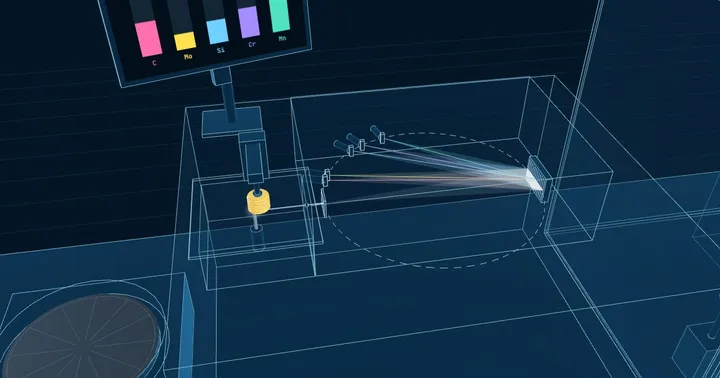
Chemical analysis (heat and product)
The steel mill analyses every heat and reports it on the certificate. A product (check) analysis samples the finished part and measures it by spark emission and combustion, or by ICP or X-ray fluorescence for nickel alloys. The result is held to the grade's limits plus the small product-analysis tolerance the specification allows. Unlike handheld PMI, it reads carbon, boron and nitrogen.