

Magnetic particle inspection (MPI)
Magnetic particle inspection finds cracks, seams and laps at or just under the surface of steel parts. The part is magnetised and coated with fine iron particles, and a defect shows up as a line of particles where it breaks the magnetic field.
Magnetise, dust, look.
- STEP 01
Clean
Oil, scale and coatings that would hide an indication are removed.
- STEP 02
Magnetise
Current through the part (a head shot) gives a circular field that finds cracks along it; a coil gives a longitudinal field that finds cracks across it. Both are used.
- STEP 03
Apply particles
Fine iron particles are applied, usually suspended in liquid and fluorescent, sometimes as a dry powder.
- STEP 04
Inspect
Fluorescent particles are viewed under UV-A light of at least 1000 µW/cm² in a booth darkened to 2 foot-candles or less; visible particles under white light.
- STEP 05
Demagnetise and clean
After inspection the part is demagnetised so it does not hold swarf, then cleaned.
- It works only on ferromagnetic steels. Austenitic stainless (B8, B8M) and most nickel alloys are not magnetic and are checked with liquid penetrant instead.
- It finds surface and near-surface defects; for the inside of a bar, ultrasonic testing is used.
Heat treatment and forging can leave cracks you cannot see.
Quench cracks from hardening, laps and bursts from heading or forging, and seams from the bar all start at or near the surface, often at the thread root or the head-to-shank fillet where a bolt carries the most stress.
MPI finds them before the part goes into service. ASTM A193 has a supplementary requirement for magnetic particle inspection of bar, and ASTM A962 one for 100% wet fluorescent inspection of the bolting, with set acceptance limits.
Grades and specifications.
What the report shows.
- Method (wet fluorescent, wet visible or dry), magnetising method and field direction.
- The acceptance criterion used and the result.
- Quantity inspected and any parts rejected.
How to ask for it.
- Ask for MPI and give the acceptance criterion: a drawing note, your specification, or the supplementary requirement to use.
- Say whether every piece or a sample is to be inspected.
Magnetic particle inspection: common questions.
Can you do MPI on stainless studs?
Not on austenitic grades such as B8 and B8M, which are not magnetic. Liquid penetrant inspection does the same job on them.
Why are two magnetising directions used?
Particles gather best where a crack lies across the magnetic field. A circular field shows cracks running along the part, a longitudinal field shows cracks across it, so both are used to catch either.
Does MPI leave the part magnetised?
It is inspected first, then demagnetised so it does not pick up chips and filings.
Often ordered with it.
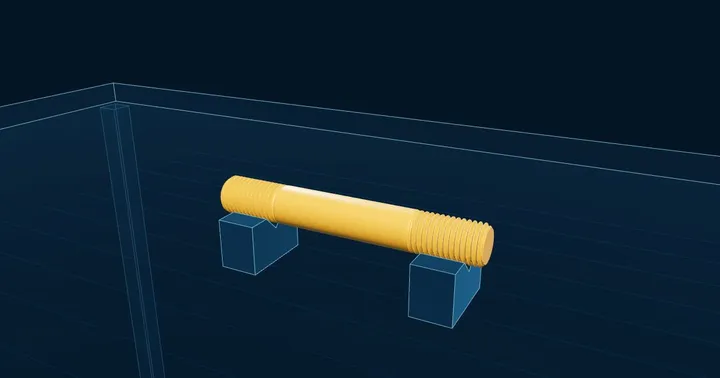
Liquid penetrant inspection (LPI)
A low-viscosity dye is drawn into any surface-breaking defect, the excess is cleaned off, and a developer pulls the trapped dye back out as a visible line. It does the job of magnetic particle inspection on materials that cannot be magnetised.
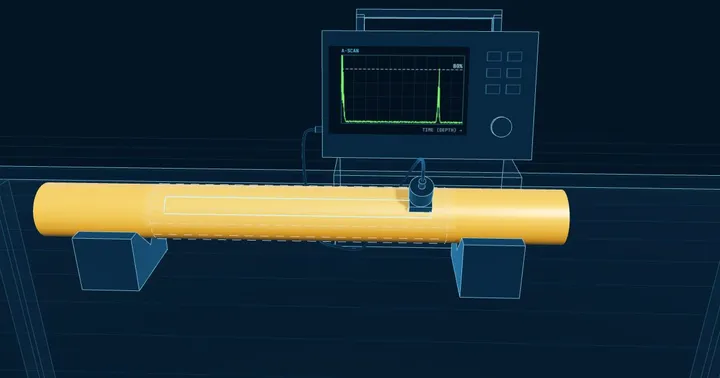
Ultrasonic testing (UT)
A transducer sends sound pulses into the part and listens for reflections. An internal void, inclusion or lamination returns an echo before the back wall does, so the whole cross-section of a large stud or bar is checked without cutting it.
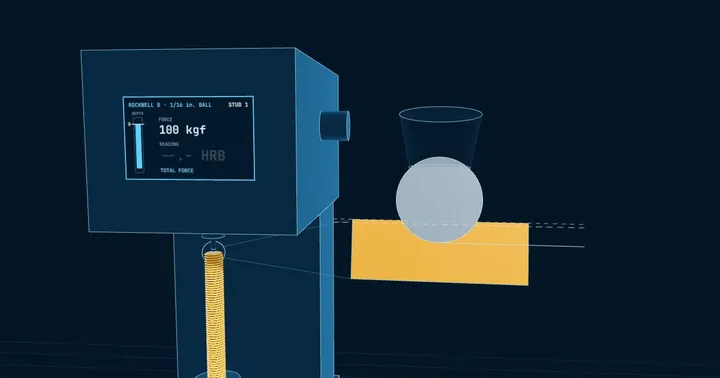
Hardness testing
A Rockwell or Brinell indenter is pressed into the part and the indentation measured. Hardness tracks the heat treatment, so it catches an under-tempered lot, and sour-service grades carry a hardness ceiling that every piece must meet.