

Proof load testing of nuts
A nut must be strong enough that the bolt fails before the threads strip. The proof load test threads the nut onto a hardened test mandrel and loads it to the proof stress for its grade: it must carry the load without stripping or breaking.
Load it, unload it, take it off.
- STEP 01
Thread onto the mandrel
The nut is threaded onto a test mandrel hardened to at least 45 HRC, with threads made to Class 3A at the small end of the tolerance.
- STEP 02
Load
The proof load for the grade and size is applied along the axis at no more than 1 in. per minute and held for at least 10 seconds.
- STEP 03
Release
The load is taken off.
- STEP 04
Check
The nut must not have stripped or broken, and it must come off by hand; a wrench may start it, for no more than half a turn.
- Nuts too large to load in a test machine (proof loads over 160,000 lbf) are proof tested only by supplementary requirement; otherwise they are hardness tested through a section.
The nut should never be the weak link.
A joint should fail in the bolt, which stretches first, not in the nut threads, which strip suddenly. So a nut's proof stress is set above the strength of its bolt: a 2H heavy hex nut is proof loaded at 175 ksi, against the 125 ksi tensile strength of a B7 stud.
ASTM A194 sets the proof stress by grade and style. The load in pounds is that stress times the thread's tensile stress area, and jam nuts are tested at 46% of the full nut's load. Where both are done, the proof load result governs over hardness.
Grades and specifications.
What the report shows.
- The proof load applied and the result.
- The lot it represents.
How to ask for it.
- Name the nut grade, style and size; the proof load comes with the specification.
- For nuts too big for the standard test, ask for supplementary requirement S4 (large nuts) if you need proof loading.
Proof load testing of nuts: common questions.
How is the proof load in pounds worked out?
The grade's proof stress times the tensile stress area of the thread. Jam nuts are tested at 46% of the full nut's load (ASTM A194).
Does a hardness test replace the proof load test?
No. Where both are done, the proof load result governs (ASTM A194).
What is a cone proof test?
A test with a 120° cone under the nut, used only when visible surface discontinuities are in question, on nuts up to 1-1/2 in., and not on Grade 8.
Why a hardened mandrel?
So the nut threads are what is tested. If the mandrel threads are damaged, the test does not count.
Often ordered with it.
Tensile testing
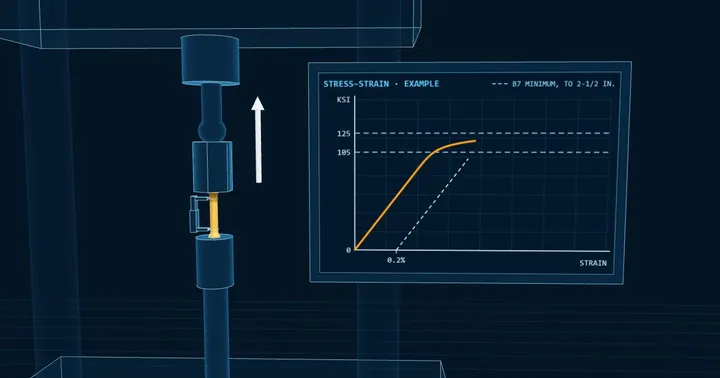
The full-size fastener is pulled to failure to prove the load it carries, and a specimen machined from the lot gives tensile strength, 0.2 percent offset yield, elongation and reduction of area. All are compared with the grade's table by diameter.
Hardness testing
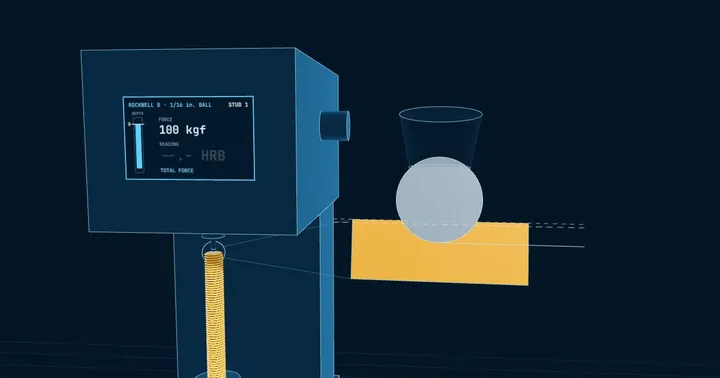
A Rockwell or Brinell indenter is pressed into the part and the indentation measured. Hardness tracks the heat treatment, so it catches an under-tempered lot, and sour-service grades carry a hardness ceiling that every piece must meet.
Thread gauging and dimensional inspection
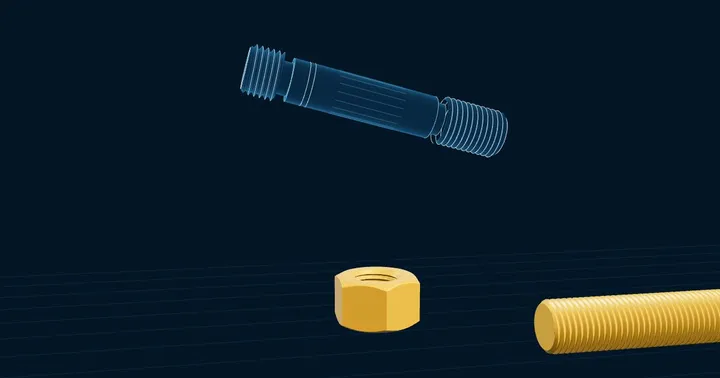
Threads are checked with Go and No-Go ring and plug gauges, and pitch diameter is measured by the three-wire method or on a thread comparator. Heads, flats, lengths and radii are measured with calibrated instruments and, for complex parts, on the CMM.