

Black oxide
Black oxide converts the surface of the steel into a black oxide in a hot oxidizing bath. It adds no appreciable thickness, so it suits socket screws and close-fitting parts. On its own it gives only very limited corrosion protection, so it is normally sealed and oiled. It is applied by outside Houston processors.
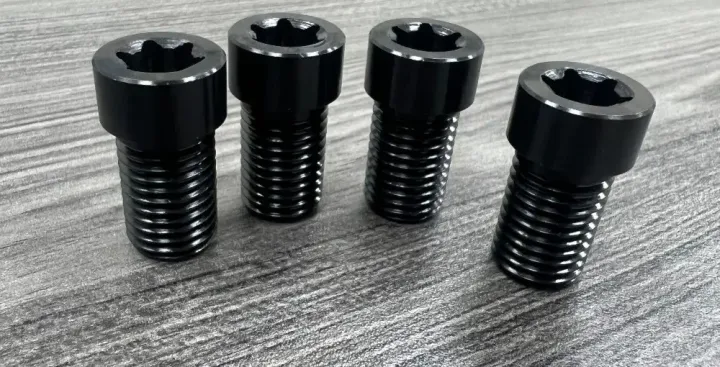
Clean, blacken, rinse, seal.
- STEP 01
Finish the part first
Black oxide goes on after all machining, forming, cold straightening and heat treatment. Parts harder than 39 HRC are stress relieved before cleaning.
- STEP 02
Clean
The steel is cleaned of rust, scale, oil and paint, without abrading it, until water sheets off it without breaking (ASTM F22 water-break test).
- STEP 03
Blacken
Class 1 parts go into a boiling alkaline oxidizing solution at about 285 to 305 °F (141 to 152 °C), typically for 5 to 60 minutes.
- STEP 04
Rinse and seal
The parts are rinsed in water and sealed with a non-chromated sealer.
- STEP 05
Relieve and preserve
Steel of 39 HRC and above gets a hydrogen relief treatment after blackening. Then the supplementary preservative, such as a water-displacing oil, goes on straight away.
- Very limited corrosion protection, and only in mildly corrosive conditions. Not recommended for long-term storage unless the parts are preserved or packed dry.
- Steel of 39 HRC and above can crack from caustic embrittlement if it is under stress in the bath.
- The process must not soften the part. Fused-salt Class 3 runs at about 750 to 850 °F (399 to 454 °C), so it is kept to stainless tempered at 900 °F (482 °C) or higher.
Finishes are applied by outside coaters and platers in Houston, to the specification on the order.
No build-up on the thread.
Black oxide produces no appreciable dimensional change, so the drawing dimensions are the dimensions after coating. A class 3A or close-fitting thread needs no allowance for it.
Alloy socket head cap screws to ASTM A574 come bright or with thermal or chemical black oxide as standard finishes, and no hydrogen embrittlement test is required for them.
The caution is the hot caustic bath. Steel of 39 HRC and above can suffer caustic embrittlement and crack if it is under stress while it is blackened. That is why the specification stress relieves hard parts before blackening and gives them a hydrogen relief treatment after it.
Designations and classes.
How to call it out.
- Name the class and the preservative, for example black oxide to MIL-DTL-13924, Class 1, with supplementary preservative to MIL-PRF-16173, Grade 3.
- Give the hardness if the parts are 39 HRC or harder, so stress relief and hydrogen relief are planned.
- For stainless parts, give the alloy and its tempering temperature, so the right class is used.
The tests behind it.
Coating thickness and salt spray
Coating thickness is measured with a magnetic or eddy-current gauge, or by X-ray fluorescence for thin platings, and checked against the class ordered. Salt-spray exposure checks corrosion protection on a sample from the lot when the specification calls for it.
Will a plated high-strength bolt crack in service?Hydrogen embrittlement relief and testing
High-strength steel can pick up hydrogen during pickling and plating and fail days later under load. Parts above 39 HRC are baked after plating to drive the hydrogen out, and a sustained-load test on fasteners from the lot proves the relief worked.
Black oxide: common questions.
Does black oxide change the thread size?
No appreciable change. MIL-DTL-13924 treats the drawing dimensions as the dimensions after coating.
Is black oxide rust-proof?
No. On its own it gives very limited protection in mild conditions; the sealer and supplementary oil add to it.
Why is it standard on socket head cap screws?
It adds no appreciable thickness to precision threads and sockets. ASTM A574 lists thermal and chemical black oxide as standard finishes that need no hydrogen embrittlement test.
How is the finish checked?
Coverage and colour are inspected, a clean white cloth is wiped over it for smut, and an oxalic acid spot test must leave a black or dark brown spot on a good coating.
Compare with.
Phosphate and oil
A manganese or zinc phosphate conversion coating that holds oil in its crystalline surface. It gives a dark grey to black finish, mild corrosion protection in storage and transit, and a good base for PTFE or paint.
Economical sacrificial protection for indoor and mild serviceZinc electroplating
A thin electroplated zinc layer with a clear, yellow or black chromate, or a chromium-free passivate. Zinc corrodes in preference to the steel underneath, so a scratch does not rust. It is the general-purpose finish for hardware that lives indoors or under cover.
Restoring the stainless surface after machiningPassivation of stainless steel
A nitric or citric acid treatment that dissolves free iron left on the surface by tooling and lets the natural chromium-oxide film reform. It is not a coating; it is how a machined stainless part gets its full corrosion resistance back.