

Cadmium plating
Cadmium plating is a soft, sacrificial coating, much like zinc, valued on military and aerospace hardware for its corrosion resistance at sea, natural lubricity and compatibility with aluminium. It is also a toxic, restricted metal, so it is supplied only where a drawing or specification still calls for it, through outside platers.
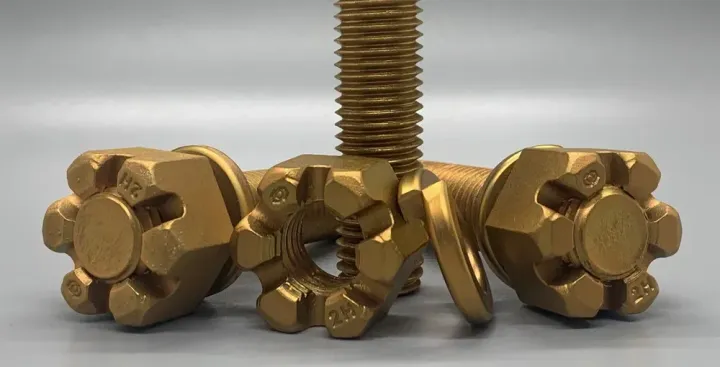
Relieve, plate, bake, convert.
- STEP 01
Stress relieve if needed
Hardened parts that were machined, ground or cold formed after heat treatment are stress relieved before cleaning, when the specification calls for it.
- STEP 02
Clean and plate
After cleaning, cadmium is electroplated to the class thickness: Class 1 at least 0.0005 in. (13 µm), Class 2 0.0003 in. (8 µm), Class 3 0.0002 in. (5 µm).
- STEP 03
Bake
High-strength steel is baked for hydrogen relief after plating. Under ASTM F1941 that is 375 to 400 °F (190 to 205 °C) for parts over 39 HRC.
- STEP 04
Convert
Type II gets a chromate conversion coat, Grade A with hexavalent chromium or Grade B without; Type III gets a phosphate as a paint base; Type I stays as plated.
- STEP 05
Check
Thickness is checked against the class, and salt spray is run when required. Type II is expected to show no white corrosion after 96 hours.
- A toxic metal: workplace exposure is regulated (OSHA 29 CFR 1910.1027), and the EU restricts cadmium plating except in sectors such as aerospace, mining, offshore and nuclear (REACH Annex XVII, entry 23).
- Heat: keep cadmium-coated bolting below 300 °F (160 °C) (ASTM A193, A194).
- Grade A conversion coats contain hexavalent chromium; Grade B is the hexavalent-free option.
- Class 1 thickness needs threads made for it.
Finishes are applied by outside coaters and platers in Houston, to the specification on the order.
Thin, lubricious, and kept cool.
Cadmium plates like zinc, so the same thread rule applies: under ASTM F1941 the plating may take up no more than a quarter of the class 2A allowance, about 0.000375 in. at the tip of a 1/2-13 thread. Class 3 (0.0002 in.) suits standard threads. Class 1 (0.0005 in.) is more than most standard threads can take without being made to a pre-plate size.
Cadmium's lubricity and consistent torque-tension on threaded parts are among the reasons military and aerospace drawings still call for it; replacements have struggled to match them.
High-strength steel needs a hydrogen relief bake after plating. ASTM F1941 bakes cadmium-plated fasteners over 39 HRC at 375 to 400 °F (190 to 205 °C), lower than zinc, because cadmium melts at about 600 °F (320 °C). ASTM A193 and A194 advise keeping cadmium-coated bolting below 300 °F (160 °C) in service.
Designations and classes.
How to call it out.
- Give the type, grade and class, for example cadmium plate to SAE AMS-QQ-P-416, Type II, Grade B, Class 3. With no grade given, Type II is supplied as Grade A.
- Give the part's hardness or tensile strength, so stress relief and baking can be planned.
- Ask whether zinc-nickel (ASTM F1941 Fe/Zn-Ni) will be accepted instead. Low-hydrogen zinc-nickel has replaced cadmium on some military parts, such as landing gear, though not yet across high-strength aerospace fasteners.
The tests behind it.
Coating thickness and salt spray
Coating thickness is measured with a magnetic or eddy-current gauge, or by X-ray fluorescence for thin platings, and checked against the class ordered. Salt-spray exposure checks corrosion protection on a sample from the lot when the specification calls for it.
Will a plated high-strength bolt crack in service?Hydrogen embrittlement relief and testing
High-strength steel can pick up hydrogen during pickling and plating and fail days later under load. Parts above 39 HRC are baked after plating to drive the hydrogen out, and a sustained-load test on fasteners from the lot proves the relief worked.
Does every dimension and thread meet the drawing?Thread gauging and dimensional inspection
Threads are checked with Go and No-Go ring and plug gauges, and pitch diameter is measured by the three-wire method or on a thread comparator. Heads, flats, lengths and radii are measured with calibrated instruments and, for complex parts, on the CMM.
Cadmium plating: common questions.
Why is cadmium still used?
For its corrosion resistance at sea, natural lubricity and consistent torque-tension on threaded parts, and because existing military and aerospace drawings call for it. Replacements have struggled to match all of these at once.
What can replace it?
Zinc-nickel, which ASTM F1941 covers on fasteners as Fe/Zn-Ni, is a leading candidate; low-hydrogen zinc-nickel already replaces cadmium on some military parts such as landing gear. Zinc-flake is another option where the drawing authority accepts it.
Does cadmium plating need a hydrogen bake?
On high-strength steel, yes, as with zinc. ASTM F1941 bakes cadmium-plated fasteners over 39 HRC at 375 to 400 °F (190 to 205 °C). AMS-QQ-P-416 sets its own requirements, which the plater follows for the revision on the drawing.
Compare with.
Zinc electroplating
A thin electroplated zinc layer with a clear, yellow or black chromate, or a chromium-free passivate. Zinc corrodes in preference to the steel underneath, so a scratch does not rust. It is the general-purpose finish for hardware that lives indoors or under cover.
High corrosion resistance without hydrogen from platingZinc-flake coating
A sprayed or dipped coating of zinc and aluminium flakes in a binder, cured rather than plated. Because it is not electroplated, the coating process itself puts no hydrogen into the steel, which makes it a common choice for high-strength bolting that needs long salt-spray life.
Uniform, hard and corrosion resistant, even inside threadsElectroless nickel
A nickel-phosphorus deposit laid down by chemical reduction rather than current, so it builds evenly on every surface, including thread roots and bores. It is harder than zinc and resists chemicals and wear.