

Single-point threading
Single-point threading cuts a thread on a CNC lathe with one insert shaped to the thread form. The insert travels along the turning part exactly one pitch per revolution, pass after pass, a little deeper each time, until the thread is to size.
One tool, many passes.
- STEP 01
Turn the diameter
The thread length is turned to size and chamfered.
- STEP 02
Lock feed to the spindle
The lathe ties the insert's travel to the spindle, one pitch per revolution: 0.125 in. per turn for an 8-thread series.
- STEP 03
First passes
Each pass starts at the same point on the turn, so the insert follows the same groove. It is fed in at a slight angle along one flank, the first-choice method for tool life and chip control.
- STEP 04
Lighter passes
Each pass is shallower than the one before. The last is very light, around 0.003 in. (0.07 mm).
- STEP 05
Gauge
GO and NOT GO gauges check the thread to its class (ASME B1.1).
- Long runs of standard threads are rolled: it is faster, and the rolled thread lasts longer in fatigue.
- A die head cuts a standard thread in one pass instead of many, so it suits quantities of standard sizes.
Any size, any form, no tooling made for the job.
The thread form comes from the insert and the pitch from the machine, with no dies or chasers made for one thread. So the same setup covers large diameters, non-standard pitches, and forms such as Acme (ASME B1.5) and buttress (ASME B1.9). Partial-profile inserts cover a range of pitches with one tool; full-profile inserts form the crest as well, for one pitch.
The last passes are very light, so the thread can be taken into a tight class, such as 3A with no allowance (ASME B1.1), and gauged to it. It is done on our CNC lathes, 27 of them in the Houston shop.
What it leaves is a cut thread: the grain is cut across and the root is not cold-worked, so under repeated loading a rolled thread lasts longer. Bolting over 2 in. that must be ultrasonically tested (ASTM A962 supplementary requirement S62) is tested before it is threaded.
Parts and features.
Single-point threading: common questions.
How many passes does a thread take?
It depends on the pitch, the material and the insert, and is set for each job. Each pass is lighter than the one before.
Which threads are single-point cut?
Ones with no dies or chasers made for them, or too few parts to justify them: Acme (ASME B1.5) and buttress (ASME B1.9) forms, non-standard pitches, and large diameters in small quantities. Standard UN threads can be cut this way too.
Can single-point threading hold Class 3A?
Class 3A has no allowance and tighter tolerances than 2A (ASME B1.1). Single-point cutting finishes with very light passes, so the thread can be taken into the tighter class and gauged to it.
Why test big studs before threading?
Ultrasonic testing needs a smooth surface for the probe. Where ASTM A962 supplementary requirement S62 applies, to bolting over 2 in., the bar is examined before the thread is cut.
Before and after it.
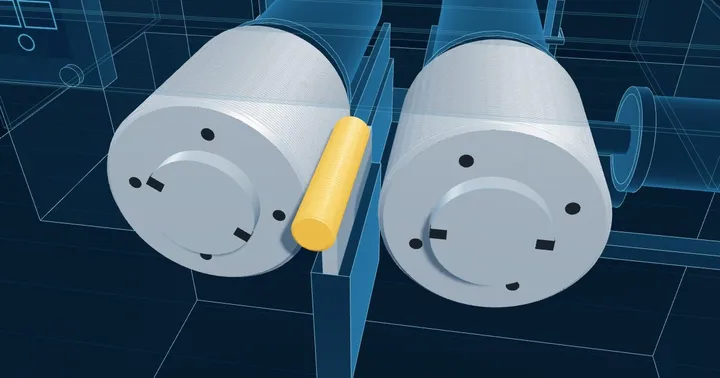
Thread rolling
Threads pressed into the bar, not cut out of it
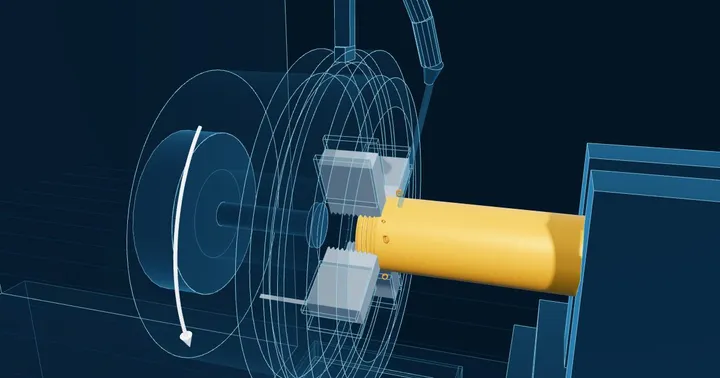
Die-head thread cutting
A ring of chasers cuts the thread in one pass, then springs open
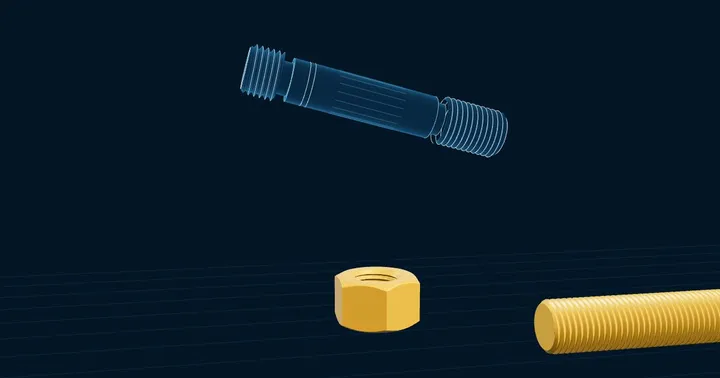
Thread gauging and dimensional inspection
Threads are checked with Go and No-Go ring and plug gauges, and pitch diameter is measured by the three-wire method or on a thread comparator. Heads, flats, lengths and radii are measured with calibrated instruments and, for complex parts, on the CMM.
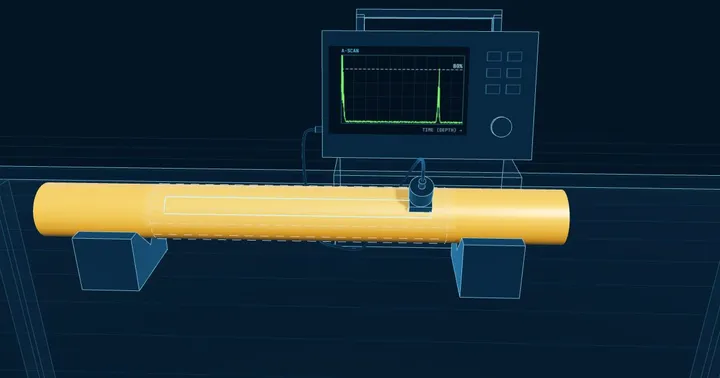
Ultrasonic testing (UT)
A transducer sends sound pulses into the part and listens for reflections. An internal void, inclusion or lamination returns an echo before the back wall does, so the whole cross-section of a large stud or bar is checked without cutting it.