

Band sawing
Studs, bolts and machined parts start as certified bar cut to length. Automatic band saws in our Houston shop feed the bar, clamp it and cut it, and the heat number from the mill certificate stays with every piece, so a finished part can be traced back to the steel it was made from.

Feed, clamp, cut, keep the heat.
- STEP 01
Check the bar in
The mill certificate is checked and the heat number recorded before the bar is used. Stainless bar arrives stamped or tagged with its heat number and grade (ASTM A484).
- STEP 02
Feed to length
The saw's shuttle vise grips the bar and pushes it forward the length set on the control. The front vise then clamps it, so nothing moves during the cut.
- STEP 03
Cut
A continuous band runs one way around two wheels. Guides twist the cutting run so the teeth face the bar, and the head feeds down at a steady rate. Coolant cools the cut, and the gullets between the teeth carry the chips out.
- STEP 04
Leave stock for what comes next
A saw cut is not a finished end. Parts that are turned next go to the lathe with stock left to face; studs cut from threaded bar go on to be chamfered.
- STEP 05
Keep the heat with every piece
Each cut piece keeps the heat identity of its bar through turning, threading and outside heat treatment, until the heat is dot-peen marked on the part itself.
- Parts made on bar-fed lathes are cut from the bar by a parting tool on the lathe, not by the saw.
- Bolts with forged heads start as sawn blanks too, but once forged they are tested as parts rather than on the bar's results (ASTM A962).
A certificate is only as good as the trace behind it.
Studs machined from heat-treated bar can be certified on the tests made on that bar (ASTM A962, which A193, A194 and A320 call up), and A193 waives the stud tension test for studs made from A193 bar already tested, unless they are heat treated again. Both hold only if every piece is known to come from that heat and lot.
Sour-service grades need a step after the saw. ASTM A193 calls for a final stress relief on B7M after all machining, cutting and forming, at least 50 °F (28 °C) below the original tempering temperature; A194 asks the same of 2HM and 7M nuts, and A320 of L7M. Parts cut after their last heat treatment go back to the outside heat treater.
Sawing in-house keeps the cut list, the heat and the job together, and an odd length or a one-off blank does not wait in another shop's queue.
Parts and features.
Band sawing: common questions.
How is a stud's length measured?
From first thread to first thread (ASTM A962, which A193 and A320 call up). The chamfered points, one to two threads long at each end, are extra, so the bar is cut longer than the length on the order.
What length tolerance applies to a stud?
ASME B18.31.2 sets it. A continuous-thread stud is held to ±0.04 in. over 3/4 to 2-1/2 in. long, ±0.08 in. to 4 in., ±0.10 in. to 8 in., ±0.12 in. to 16 in. and ±0.18 in. above that; double-end studs are held closer.
Does sawing change the material?
Not its grade or heat. But B7M and L7M studs and 2HM and 7M nuts must be stress relieved after all cutting and machining, so those parts go back through the heat treater after the saw and the lathe.
How does the heat number reach the part?
The heat identity travels with each piece from the saw and is dot-peen marked on the part with the grade and maker's marks. Where an order calls for lot traceability marking, ASTM A962 supplementary requirement S66 has a traceability code hard-marked on each part and reported on the certificate.
Before and after it.
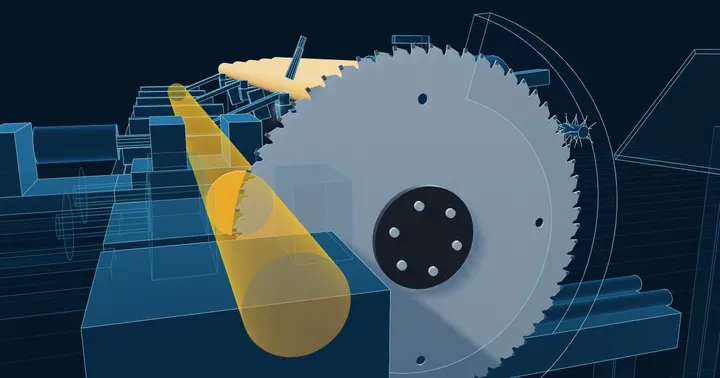
High-speed circular sawing
Fast, clean cuts on repeat bar lengths
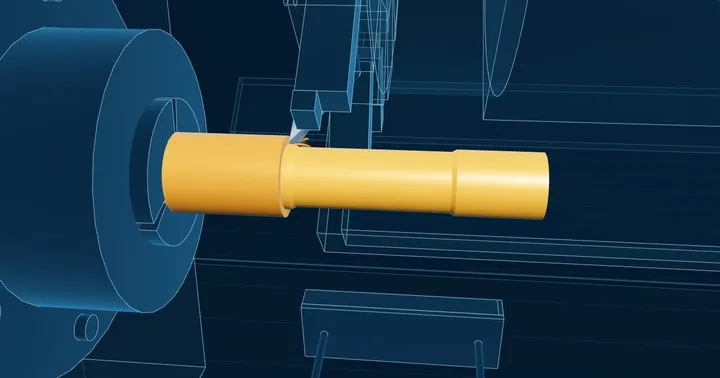
CNC turning
Studs, collars, nuts and parts from bar
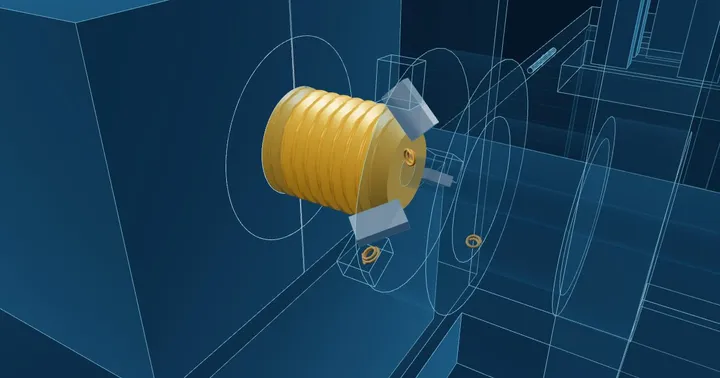
Chamfering
Stud and bolt ends finished to start the nut
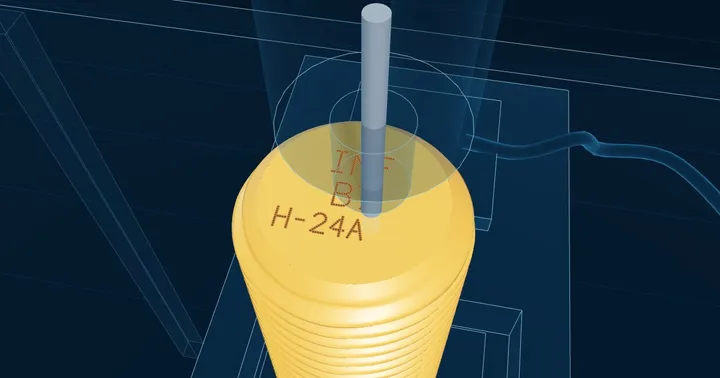
Dot-peen marking
Grade, maker and heat marked into the part, dot by dot
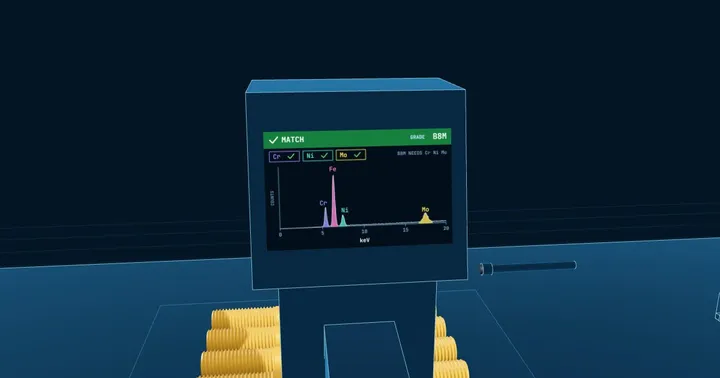
Positive Material Identification (PMI)
A handheld X-ray fluorescence analyser reads the chemistry of the finished part in seconds and matches it to the grade. It confirms that a B7 is chromium-molybdenum steel and not plain carbon, that a B8M has its molybdenum, and that a nickel-alloy stud is the alloy on the certificate. Handheld XRF does not read carbon, so carbon is confirmed from the mill certificate or by spark (OES) analysis.