

Thread rolling
Thread rolling presses a thread into a plain blank between hardened dies. Nothing is cut away: the die crests push metal down to form the roots, and it flows up the flanks to form the crests. So the blank starts at about the thread's pitch diameter and grows to full size.

Pressed in, not cut out.
- STEP 01
Size the blank
The part is turned to about the thread's pitch diameter, midway between crest and root. For a 1-1/4-8 UN thread that is about 1.16 in.
- STEP 02
Set it between the dies
The blank rests on a work-rest blade between two cylindrical dies on side-by-side spindles. The dies carry the thread form: their crests make the part's roots.
- STEP 03
Roll
Both dies turn the same way, so the blank turns the other way between them while one die head feeds in. In this infeed rolling the blank stays put along its axis, so the thread can be no longer than the dies are wide.
- STEP 04
Displace the metal
Each turn presses the die crests a little deeper. The metal under them flows up the flanks, so the outside diameter grows to the major diameter while nothing is removed.
- STEP 05
Dwell and release
The dies stop feeding and the part turns a few more times to round the thread, then the dies open.
- STEP 06
Gauge
GO and NOT GO gauges check the thread to its class: Class 2A unless the order says otherwise (ASTM A962).
- STEP 07
Through-feed long threads
For threaded rod and other threads longer than the dies, ring dies are fitted and both die heads are tilted by the thread's lead angle, in opposite directions. The bar is fed in from the front and then screws itself through, one pitch a turn: the dies' tapered entry forms the thread gradually, and it leaves at the back of the machine, fully rolled.
- Very large or coarse threads need more metal moved than rolling can manage; they are cut with a die head or on a CNC lathe.
- Brittle materials cannot be rolled, because the metal has to flow cold. Their threads are cut.
- Rolling needs room at a shoulder: some rolling heads cannot form the last 1-1/2 to 2 threads next to one. Threads that must run closer are cut.
- Acme, buttress and other special forms need rolling dies made for the job, so on short runs they are single-point cut instead.
Fatigue cracks start at thread roots. Rolling puts the root in compression.
A bolt loaded on and off usually breaks in the thread, where the stress is concentrated. Rolling cold-works the root and leaves it in compression, much like shot peening, and the grain of the bar follows the thread instead of being cut across. In one published test on M12 quenched-and-tempered alloy bolts, rolled threads reached about two and a half times the fatigue strength of cut threads.
When the thread is rolled matters. Heat treatment after rolling recrystallises the root and removes the compressive stress, so the full benefit comes from rolling after the bar is hardened and tempered. In university tests on high-strength 3/8 in. bolts, rolling after heat treatment raised fine-thread fatigue strength by roughly 40 to 50%, with little gain on coarse threads. ASTM A962, behind A193, A194 and A320, requires threads to be formed after heat treatment unless the parts are heat treated in controlled-atmosphere furnaces.
The sour-service grades are the exception. B7M studs get a final stress relief at least 50 °F (28 °C) below their tempering temperature after all machining and forming (ASTM A193), and L7M a final temper or stress relief at 1150 °F (621 °C) minimum after the threads are rolled or cut (ASTM A320). Every piece is then hardness tested to the 235 HBW cap.
Parts and features.
Thread rolling: common questions.
Why is the blank smaller than the thread?
Because nothing is cut away. The blank is about the pitch diameter, and the metal pressed down at the roots rises into the crests. That is why a rolled thread can sit on a body as small as the minimum pitch diameter, while a cut thread needs a full-size body (ASTM F1554, Table 4).
Should threads be rolled before or after heat treatment?
After, for the best fatigue life: heat treatment after rolling removes the compressive stress at the root. ASTM A962 requires threads after heat treatment unless the parts are heat treated in controlled-atmosphere furnaces, and ASTM A320 asks for it wherever practical. B7M and L7M then get a final stress relief or temper.
Is a rolled thread stronger than a cut one?
In fatigue, usually. One published test on alloy-steel bolts found rolled threads about two and a half times stronger in fatigue, though a highway study of anchor bolts found the two about the same except at low stress ranges, where the rolled threads lasted longer. In tension, ASTM A193 and A320 set the same minimum strength however the thread is made.
Can I specify rolled threads?
Yes, on the order. Most specifications leave the choice to the manufacturer (ASTM F3125 and F1554 allow rolled or cut). ASTM A574 socket head cap screws up to 0.625 in. and 4 in. long must be roll threaded unless the purchaser says otherwise, and ASTM A453 has thread types for rolling after (R1) or before (R2) the final ageing treatment.
Before and after it.
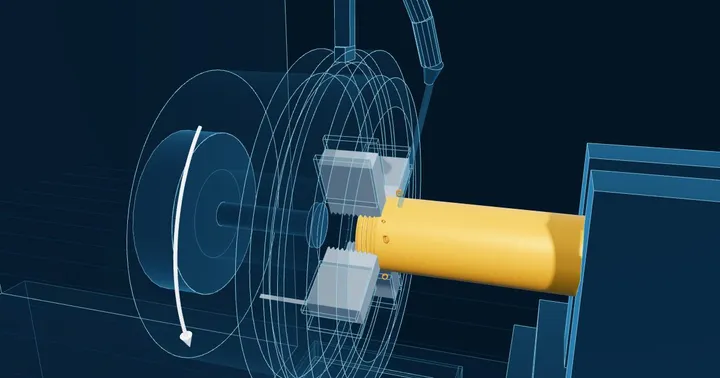
Die-head thread cutting
A ring of chasers cuts the thread in one pass, then springs open
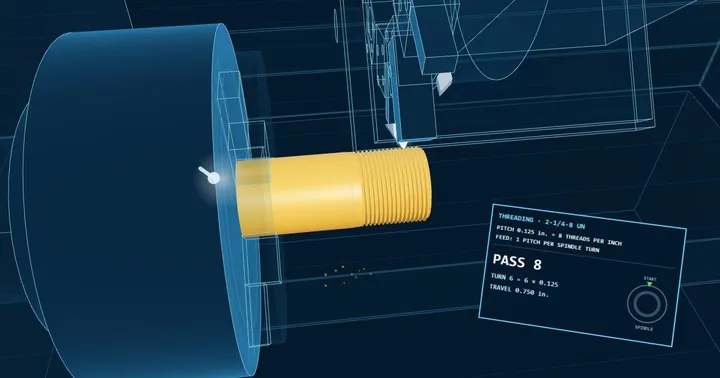
Single-point threading
One insert, many passes: any size or form on a CNC lathe
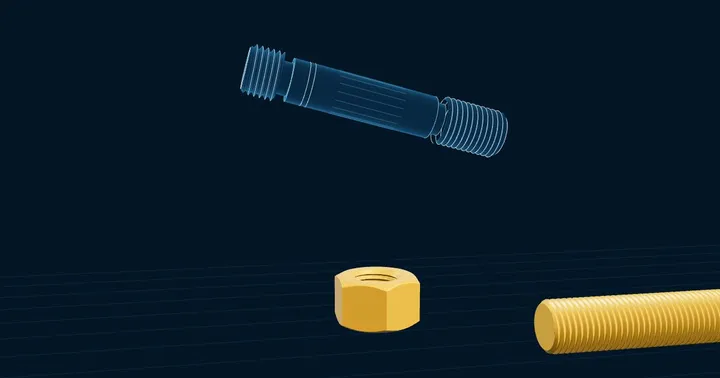
Thread gauging and dimensional inspection
Threads are checked with Go and No-Go ring and plug gauges, and pitch diameter is measured by the three-wire method or on a thread comparator. Heads, flats, lengths and radii are measured with calibrated instruments and, for complex parts, on the CMM.
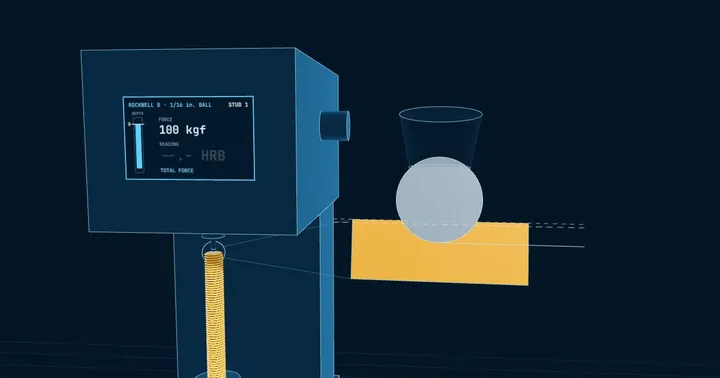
Hardness testing
A Rockwell or Brinell indenter is pressed into the part and the indentation measured. Hardness tracks the heat treatment, so it catches an under-tempered lot, and sour-service grades carry a hardness ceiling that every piece must meet.

Macroetch
A slice cut from the bar or from a sample forging is etched in hot acid and examined by eye or at low magnification. It shows pipe, porosity, cracks, seams and segregation, and the flow lines left by forging. It is rated against graded standard photographs.