

A453 660 (A-286) Stud Bolts
A-286 bolting for the hottest joints — 130 ksi at room temperature and rated by stress-rupture at 1200 °F, for gas and steam turbines, exhaust and high-temperature process equipment.
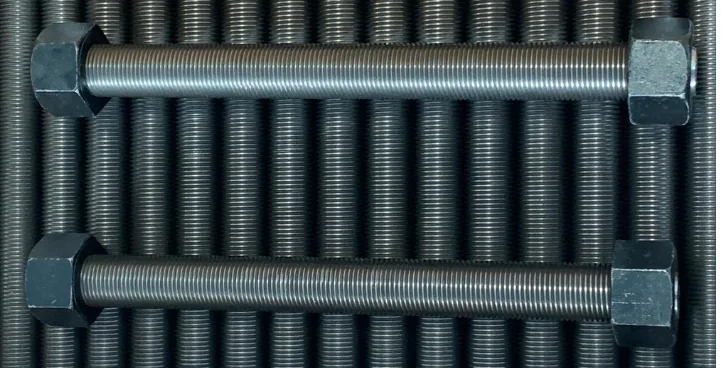
Threaded rod inserted through the holes of mating flanges, paired with heavy hex nuts. Available in every diameter and length, imperial and metric, for flanged connections in critical service. Supplied bare or coated, with full material traceability.
ASTM A453 Grade 660 covers bolting in A-286, an iron-nickel-chromium superalloy strengthened by titanium and aluminum precipitates. Unlike the A193 grades it is qualified by room-temperature tensile properties and, for design temperatures above 800 °F, by a stress-rupture test at 1200 °F, because its purpose is to hold clamp load at temperatures where B16 and the austenitic stainless grades have already relaxed.
Hot-shot or plant down? Call 832-446-3442, answered 24/7.
What A453 660 (A-286) must meet.
| Class and size | Tensile strength, min (ksi) | Yield strength 0.2% offset, min (ksi) | Elongation in 4D, min (%) | Reduction of area, min (%) | Hardness |
|---|---|---|---|---|---|
| Class A — all sizes | 130 | 85 | 15 | 18 | 248–341 HBW / 24–37 HRC |
| Class B — all sizes | 130 | 85 | 15 | 18 | 248–341 HBW / 24–37 HRC |
| Class C — all sizes | 130 | 85 | 15 | 18 | 248–341 HBW / 24–37 HRC |
| Class D — 2½ and under | 130 | 105 | 15 | 18 | 248–321 HBW / 24–35 HRC |
| Class D — over 2½ | 120 | 95 | 15 | 18 | 248–321 HBW / 24–35 HRC |
Values per ASTM A453/A453M-17 (verified against the specification). Confirm the edition called out on your purchase order with our estimating team.
Solution treated and precipitation hardened per the class ordered (see table). Hardness is checked after aging; stress-rupture specimens are tested per heat-treat lot.
Full A453 660 data sheet: chemistry, physical properties and standards →
Made to standard or to your drawing.
- Gas turbine casing, combustor and exhaust bolting
- Steam turbine bolting above the range of B16
- Turbochargers and engine exhaust manifolds
- High-temperature process reactors and furnaces
- Cryogenic-to-1300 °F service where thermal expansion must match stainless