

What do 2A, 2B, 3A and 3B thread fits mean?
The number and letter after an inch thread set its tolerance class under ASME B1.1: A is an external thread (the stud or bolt), B an internal thread (the nut). Class 1 is the loosest, 2 the standard and 3 the tightest.
Class 2A has a small built-in clearance, called the allowance, so parts assemble easily and thin plating fits; 3A has no allowance and a tighter tolerance. Unless the order says otherwise, ASTM A962 calls for 2A threads on stud bolts and 2B on nuts.
The classes at a glance
| Class | Applies to | Allowance | Tolerance | Typical use |
|---|---|---|---|---|
| 1A / 1B | External / internal | Yes (1A) | Loosest | Quick assembly with dirty or damaged threads; rarely specified today |
| 2A / 2B | External / internal | Yes (2A) | Standard | Most bolts, studs and nuts, including pressure bolting |
| 3A / 3B | External / internal | None | Tightest | Where a close fit is specified: precision assemblies, socket products, some special studs |
Internal threads (B classes) have no allowance in any class. The classes are interchangeable: a 2A stud assembles into a 3B nut and a 3A stud into a 2B nut.
What stud bolts and nuts are made to
ASTM A962, the general requirements behind A193 and A320 stud bolts, sets the default when the purchase order is silent:
- Studs and bolts: ASME B1.1 Class 2A. Sizes 1" and smaller are coarse thread (UNC); 1-1/8" and larger are eight-pitch (8UN).
- Nuts: ASME B1.1 Class 2B, gauged to ASME B1.2. Up to 1", UNC; over 1", 8UN. ASTM A194 also allows UNC on nuts over 1" but furnishes 8UN unless told otherwise.
- Metric equivalents: 6g on the stud and 6H in the nut (ASME B1.13M).
When 3A is called for
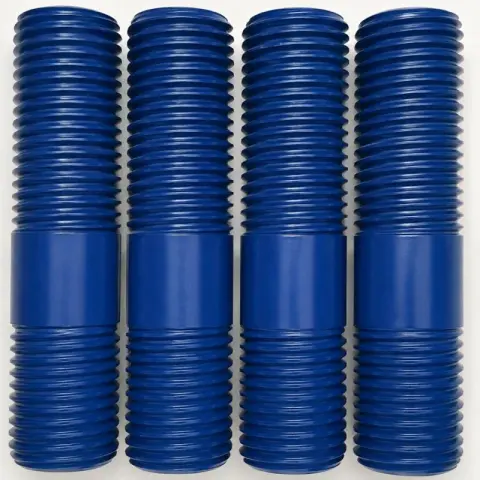
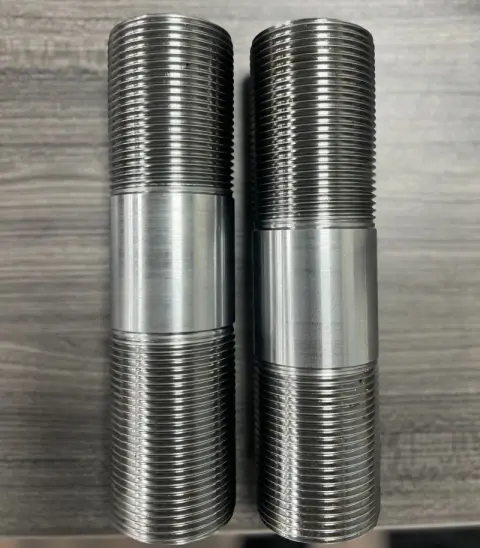
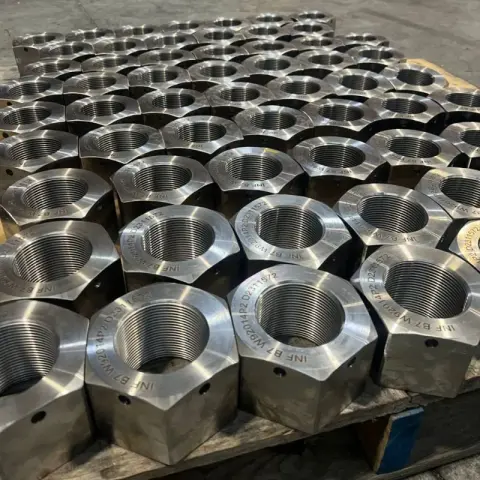
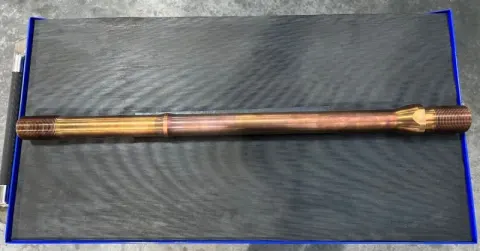
A 3A thread is specified when the designer wants a closer fit than standard: socket head cap screws, studs that locate a part, tapped holes in valve bodies and equipment where the fit is controlled, and special parts made to drawing. Some studs carry a 3A thread on one end and 2A on the other, matched to a tapped hole and a nut. The jobs below are examples we have made.
3A costs more to make and inspect, and because it has no allowance it leaves no room for plating. If a 3A part also needs a coating, the thread has to be cut undersize to allow for it, and the drawing should say so.
Coated and galvanized threads
The 2A allowance is small, enough for thin electroplating, but not for thick coatings. Hot-dip galvanizing is far thicker, so galvanized assemblies keep the bolt thread at its size and tap the nut oversize instead. PTFE (Xylan) coatings also build up on the flanks; tell us the coating at the quote stage so the thread is sized for it.
How threads are checked
Threads are gauged with GO and NO-GO thread ring gauges for external threads and plug gauges for internal threads, to the class on the drawing. Our thread and dimensional inspection page shows how.
Real jobs.
Also asked.
Will a 2A stud fit a 3B nut?
Yes. All inch thread classes of the same size and pitch are interchangeable; the class only changes how close the fit is.
Why are large stud bolts 8 threads per inch?
ASTM A962 calls for the 8UN series on studs 1-1/8" and larger. The finer constant pitch keeps more of the stud's section and suits large-diameter pressure bolting.
Does 3A make a stronger bolt?
No. Strength comes from the material and heat treatment. 3A only controls the fit and costs more to make and inspect.
What thread class is a UNJ thread?
UNJ threads (UNJC, UNJF) have a controlled root radius and are normally made to Class 3A / 3B under ASME B1.15; they are common in aerospace-derived parts.