

Dot-peen marking
A carbide-tipped pin strikes the part many times a second, building each character from small dots. It puts on the marks the specification asks for, the grade symbol and the manufacturer's identification, with the heat identity alongside, so the part can be traced to its mill certificate.

Dot by dot.
- STEP 01
Clamp the part
The stud, bolt or nut is held still under the marking head, stud end or bolt head up.
- STEP 02
Set the text
Our manufacturer's identification, INF, the grade symbol under it and the heat code under that are programmed for the job.
- STEP 03
Strike
The pin, driven by an electromagnet or by air, strikes many times a second as the head moves, each strike leaving a small round dot.
- STEP 04
Characters form
The dots run together into letters and numbers. The depth is adjustable to suit the part.
- STEP 05
Trace
The heat code on the part is the heat on the material test report, which ties the part to its mill certificate.
- Where an indentation is not wanted, on thin walls or cosmetic faces, a non-indenting method such as laser marking is used.
- Bar and threaded bar shipped bundled and tagged, or boxed, need not be marked piece by piece: the tag carries the grade symbol and the maker's identification (ASTM A962).
- Studs under 3/8 in. and bolts under 1/4 in. need no marking under ASTM A962; supplementary requirement S50 extends marking to all sizes, and the smallest parts are marked by agreement.
A B7 and a B7M look the same. The marking tells them apart.
ASTM A962, behind A193, A194 and A320, requires the grade symbol and the manufacturer's identification on one end of studs 3/8 in. (10 mm) and larger, on the heads of bolts 1/4 in. (6 mm) and larger, and on every nut whatever its size. Bolts are marked on top of the head, never on the bearing face; A194 nuts on one face, not the wrench flats.
The symbol says more than the grade. A194 adds a B to nuts machined from bar (2HB) and an L to nuts impact tested for low temperature (7L); A193 marks strain-hardened Class 2 B8 as B8SH; zinc- or cadmium-coated bolting adds ZN or CD (supplementary requirements); bolting that meets two grades may carry both, such as B7/L7.
The marks go where they do no harm: the stud end and the top of the head, away from the thread and the bearing face. In published fatigue tests on bridge steel, marks made with an impact-stylus system did not lower the fatigue design category. ASTM A962 supplementary requirement S66 goes further: a lot code hard-marked on each piece and reported on the certificate.
Parts and features.
Dot-peen marking: common questions.
What must be marked on an A193 B7 stud?
The grade symbol, B7, and the manufacturer's identification (ours is INF), on one end of studs 3/8 in. and larger (ASTM A962). A heat or lot mark is required only when the order calls for it, for example A962 supplementary requirement S66. We also mark the heat identity, so the stud traces to its certificate.
Why does my nut say 2HB and not 2H?
ASTM A194 adds a B to nuts machined from bar stock. A 2HB nut is a 2H nut; the letter records how it was made.
Is dot-peen marking the same as stamping?
No. A stamp drives a whole character in one blow; a dot-peen pin builds it from many small round dots. Ordinary stamps leave a sharp V; low-stress stamps and dot marks have round bottoms.
What happens to the marking if parts are re-machined or re-heat-treated?
It has to change with them: ASTM A962 makes whoever certifies the altered part responsible for re-marking it and removing the previous maker's symbol.
Before and after it.
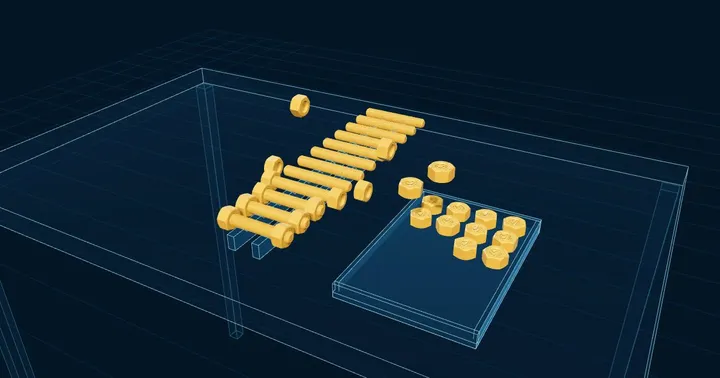
Stud bolt assembly
Studs paired with heavy hex nuts, counted and boxed by flange
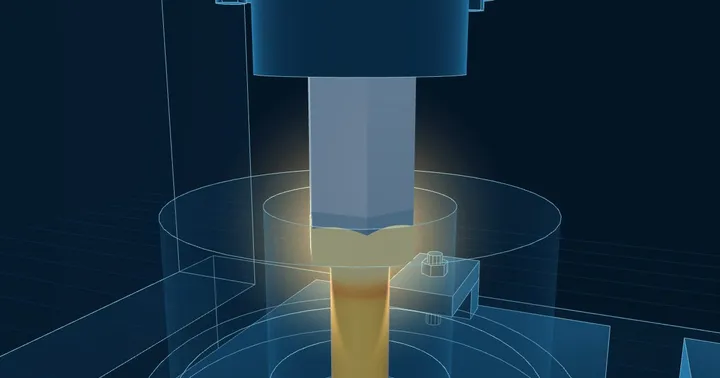
Hot forging
Bolt heads and heavy hex nuts formed from red-hot bar
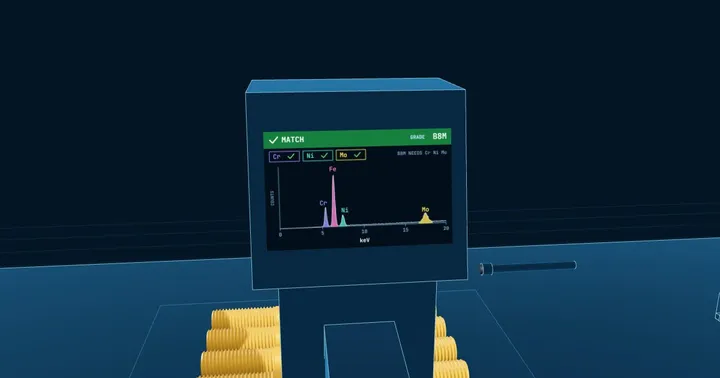
Positive Material Identification (PMI)
A handheld X-ray fluorescence analyser reads the chemistry of the finished part in seconds and matches it to the grade. It confirms that a B7 is chromium-molybdenum steel and not plain carbon, that a B8M has its molybdenum, and that a nickel-alloy stud is the alloy on the certificate. Handheld XRF does not read carbon, so carbon is confirmed from the mill certificate or by spark (OES) analysis.
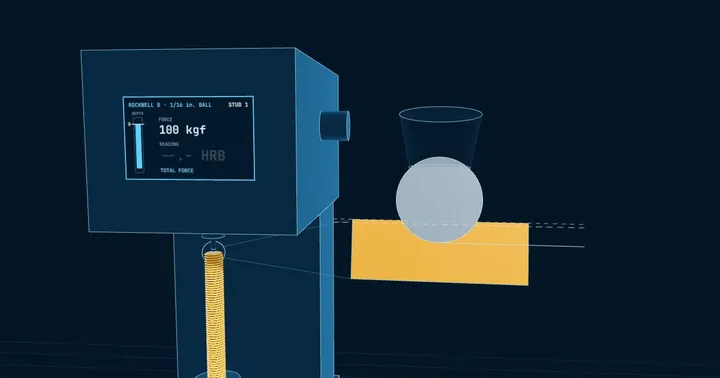
Hardness testing
A Rockwell or Brinell indenter is pressed into the part and the indentation measured. Hardness tracks the heat treatment, so it catches an under-tempered lot, and sour-service grades carry a hardness ceiling that every piece must meet.
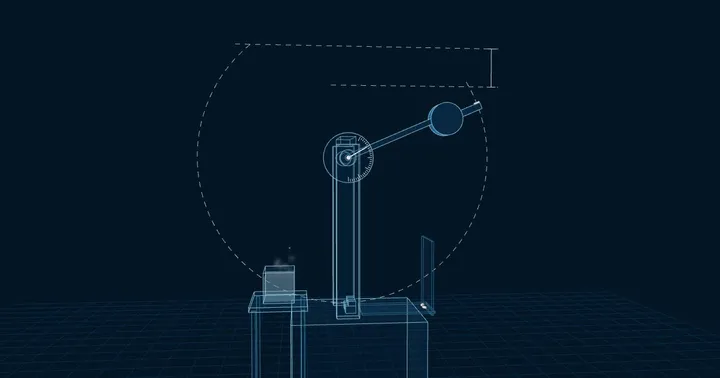
Charpy V-notch impact testing
A notched specimen machined from the lot is chilled to the test temperature and struck by a swinging hammer; the energy it absorbs before breaking is the result. Low-temperature grades must absorb a minimum energy at temperature, which is the difference between a B7 and an L7.