

Stud bolt assembly
A flanged joint is held by stud bolts, each a threaded stud with a heavy hex nut at each end. We run the nuts onto their studs, count them into sets by flange size and pressure class, and bag, box and label each set so it reaches the right flange.
Pair, count, bag, box.
- STEP 01
Match the grades
Each stud grade takes its nut grade: B7 studs usually take A194 2H nuts, while ASTM A320 requires Grade 7 nuts on L7 studs and Grade 8-family nuts on A320 B8.
- STEP 02
Match the threads
Studs and nuts carry matching threads: UNC up to 1 in. and 8 UN above, Class 2A on the stud and 2B in the nut, unless the order says otherwise (ASTM A962).
- STEP 03
Two nuts per stud
Every stud gets two heavy hex nuts, one for each side of the joint.
- STEP 04
Count by flange
Studs are counted into sets from the flange table for the size and class: an NPS 6 Class 300 flange takes 12 studs of 3/4 in. (ASME B16.5).
- STEP 05
Bag, box and label
Each set is bagged, then packed in a brown box printed with our logo, and the box is labelled for the joint it belongs to. The label carries the customer, the packing list and PO numbers, the heat or lot number and the cert number that tie the set to its test report, the part number and description, the quantity and the box count.
- For coated sets, the studs and nuts are coated by an outside Houston processor; hot-dip galvanized nuts are tapped oversize after coating so they fit (ASTM A563).
- ASME B16.47 Series A and Series B flanges of the same size and class are not interchangeable, so the series must be on the order.
The right studs, in the right number, at the right flange.
ASME B16.5 (NPS 1/2 to 24, Classes 150 to 1500, and Class 2500 up to NPS 12) and B16.47 (NPS 26 to 60) set the number and diameter of the bolts for each flange size and class, so the count comes straight from the table. The studs follow ASME B18.31.2 unless the order says otherwise (ASTM A962).
Stud length is measured from first thread to first thread, without the points, and each point is one to two threads long (ASTM A193, A962). The nuts are heavy hex unless otherwise specified, and their proof load is set above the stud's strength: a 2H heavy hex nut is proof loaded at 175 ksi against the 125 ksi tensile strength of a B7 stud.
Grades that look alike must not be mixed: a B7 and a B7M stud, or a 2H and a 2HM nut, look the same and are told apart only by their marking. That is why every part carries its grade marking, and why PMI can be ordered on mixed-grade orders.
Parts and features.
Stud bolt assembly: common questions.
How is stud bolt length measured?
From first thread to first thread, not counting the chamfered points; each point is one to two threads long (ASTM A193, A962).
How many studs does a flange take?
As many as it has bolt holes, from the ASME B16.5 or B16.47 table for its size and class: 12 studs of 3/4 in. for an NPS 6 Class 300 flange, for example. Send your flange list and we will count the sets.
Which nut goes with which stud?
B7 studs usually take A194 2H nuts. L7 studs must take Grade 7 nuts, impact tested and marked L (ASTM A320). For sour service the M grades go together: B7M studs with 2HM nuts, L7M with 7M.
Why heavy hex nuts?
They are the default for this bolting (ASTM A962), and their proof load is set above the stud's strength, so the stud, not the nut thread, is the weak link: 175 ksi for a 2H heavy hex nut against 125 ksi for a B7 stud.
Before and after it.
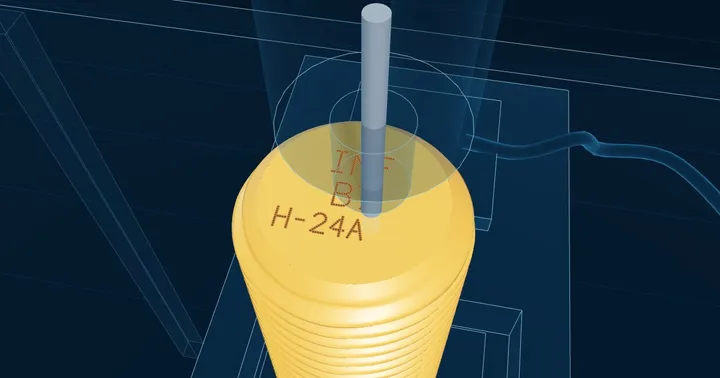
Dot-peen marking
Grade, maker and heat marked into the part, dot by dot
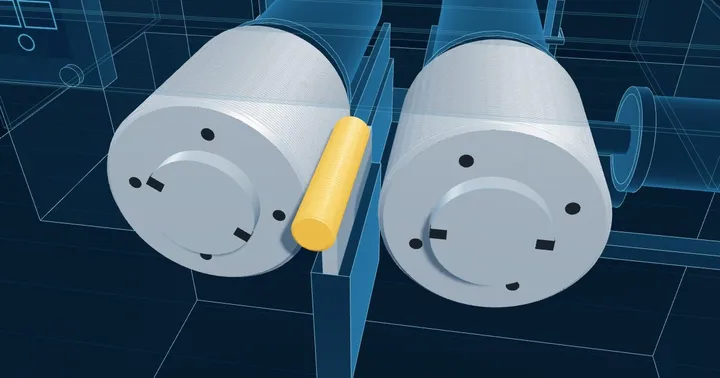
Thread rolling
Threads pressed into the bar, not cut out of it

Proof load testing of nuts
The nut is threaded on a hardened mandrel and loaded to the proof stress for its grade and size. It passes if the threads neither strip nor break and it can be removed by hand afterwards; a wrench may start it, for up to half a turn.
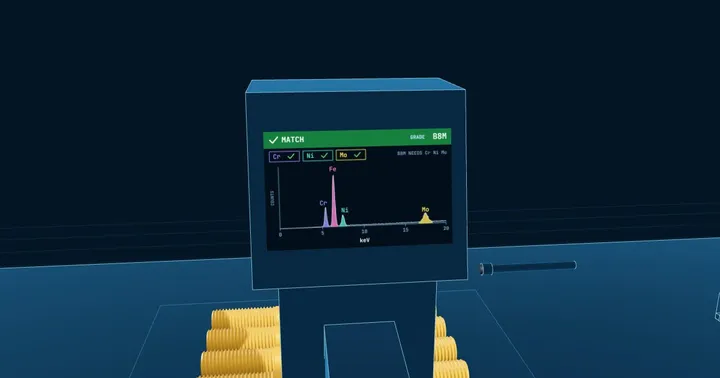
Positive Material Identification (PMI)
A handheld X-ray fluorescence analyser reads the chemistry of the finished part in seconds and matches it to the grade. It confirms that a B7 is chromium-molybdenum steel and not plain carbon, that a B8M has its molybdenum, and that a nickel-alloy stud is the alloy on the certificate. Handheld XRF does not read carbon, so carbon is confirmed from the mill certificate or by spark (OES) analysis.
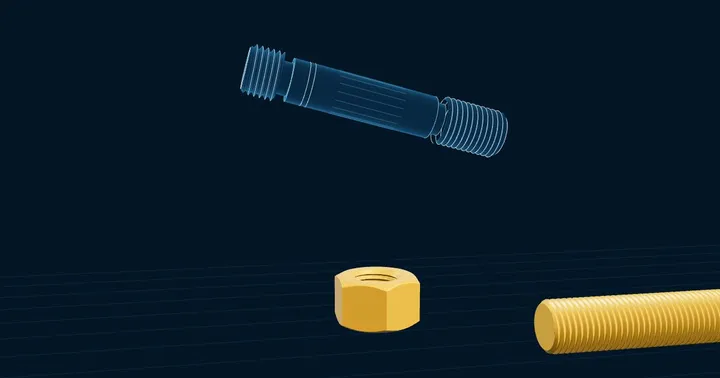
Thread gauging and dimensional inspection
Threads are checked with Go and No-Go ring and plug gauges, and pitch diameter is measured by the three-wire method or on a thread comparator. Heads, flats, lengths and radii are measured with calibrated instruments and, for complex parts, on the CMM.