

Shutdown & Turnaround Bolting — Planned Sets and 24/7 Cover
For a planned shutdown, turnaround or outage we make the stud bolts, nuts and special fasteners on your bolting list, count them into sets by flange, and bag, box and label each set for its joint. During the job, the 24/7 line — 832-446-3442 — covers what inspection finds: a seized stud, a damaged thread, a grade nobody stocked.
The earlier the list arrives, the less of the job depends on emergency work. Grades that need outside heat treatment or coating, orders with Charpy, PMI or 3.2, and large or exotic bar all need time that a planned order has and an emergency does not.
What we make, and what happens after machining.
| Grade | UNS | After machining | Chosen for |
|---|---|---|---|
| A193 B7 | G41400 · G41420 · G41450 | Nothing — Q&T bar | Most flange bolting on a refinery or chemical unit. |
| A193 B7M | G41400 · G41420 · G41450 | Stress relief, outside | Sour units: amine, sulfur recovery, hydrotreating. |
| A194 2H | — | Q&T nut | The nut for B7. |
| A320 L7 | G41400 · G41420 · G41450 | Nothing — Q&T bar | Cold sections, refrigeration and LNG trains. |
| A193 B16 | K14072 | Nothing — Q&T bar | Steam turbines and HP steam in power outages. |
| A193 B8M Class 1 | S31600 | Nothing | Stainless and coastal-plant piping. |
| Duplex 2205 | S31803 · S32205 | Nothing — solution annealed | Seawater and chloride systems. |
| Inconel 718 | N07718 | Nothing — we hold aged bar | High-strength nickel-alloy joints. |
Where these parts go.
- Refinery unit turnarounds: exchangers, columns, reactors and piping.
- Chemical plant shutdowns.
- Power station outages: turbines, boilers and valves.
- LNG train and gas plant maintenance.
- Terminal and pipeline maintenance.
So we can start on the call.
- The bolting or flange list: NPS, pressure class, B16.5 or B16.47 (Series A or B), and quantities.
- Grades, coatings and certification: 3.1 or 3.2, PMI, Charpy, NACE MR0175.
- The date each work pack is needed.
- How each set should be labelled — joint, flange or tag number.
- The spares you want held back for the joints most likely to need them.
Plan the slow steps; keep the fast ones for the surprises.
- Lock grades and coatings early: outside heat treatment and coating are the longest steps.
- Ask for PMI on mixed-grade orders, so B7 and B7M, or 2H and 2HM, cannot be mixed.
- ASME B16.47 Series A and Series B flanges of the same size and class are not interchangeable; put the series on the list.
- Keep our number with the turnaround crew: 832-446-3442, answered 24/7, with hot-shot across the Gulf Coast.
Heat treatment and coating are done by approved Houston processors, outside our shop. Every lot ships with an EN 10204 3.1 report; certification & traceability.
Order them at the start.
Positive Material Identification (PMI)
A handheld X-ray fluorescence analyser reads the chemistry of the finished part in seconds and matches it to the grade. It confirms that a B7 is chromium-molybdenum steel and not plain carbon, that a B8M has its molybdenum, and that a nickel-alloy stud is the alloy on the certificate. Handheld XRF does not read carbon, so carbon is confirmed from the mill certificate or by spark (OES) analysis.
Is the heat treatment right, and is it soft enough for sour service?Hardness testing
A Rockwell or Brinell indenter is pressed into the part and the indentation measured. Hardness tracks the heat treatment, so it catches an under-tempered lot, and sour-service grades carry a hardness ceiling that every piece must meet.
Will it stay tough in the cold?Charpy V-notch impact testing
A notched specimen machined from the lot is chilled to the test temperature and struck by a swinging hammer; the energy it absorbs before breaking is the result. Low-temperature grades must absorb a minimum energy at temperature, which is the difference between a B7 and an L7.
Does every dimension and thread meet the drawing?Thread gauging and dimensional inspection
Threads are checked with Go and No-Go ring and plug gauges, and pitch diameter is measured by the three-wire method or on a thread comparator. Heads, flats, lengths and radii are measured with calibrated instruments and, for complex parts, on the CMM.
Will the nut carry the bolt's full load?Proof load testing of nuts
The nut is threaded on a hardened mandrel and loaded to the proof stress for its grade and size. It passes if the threads neither strip nor break and it can be removed by hand afterwards; a wrench may start it, for up to half a turn.
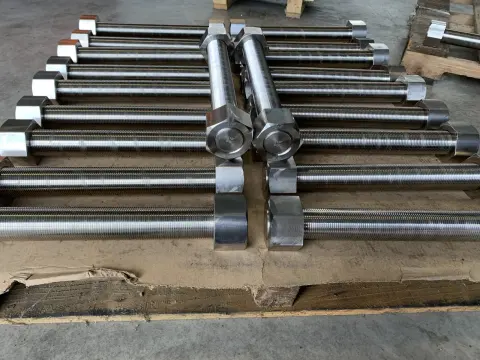
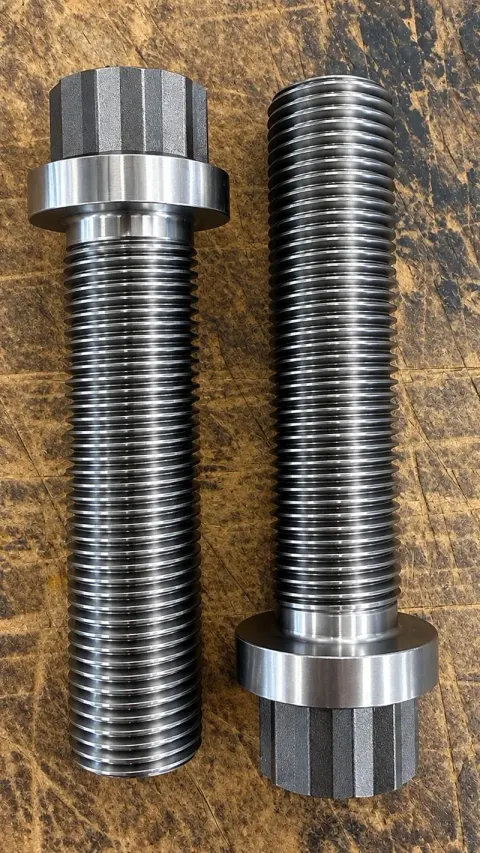
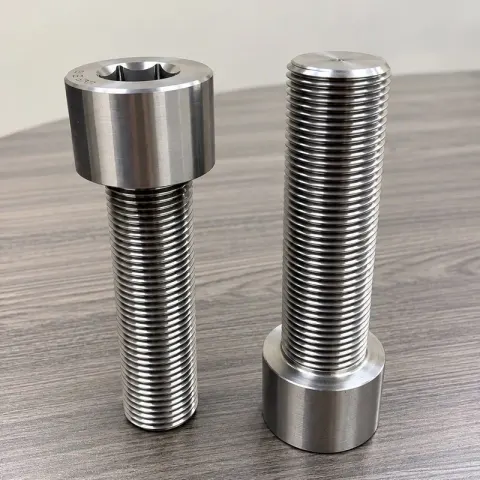
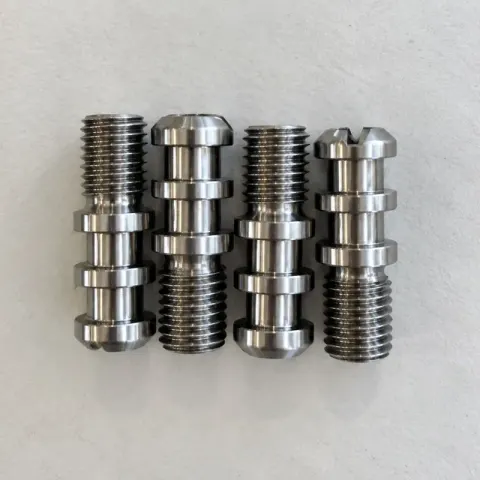
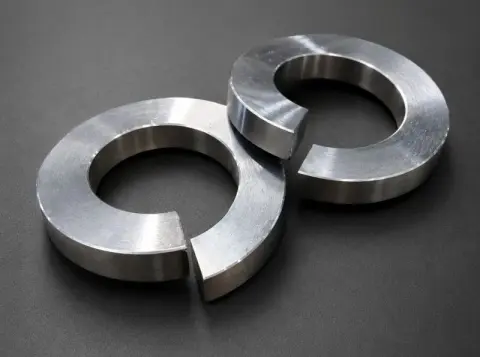
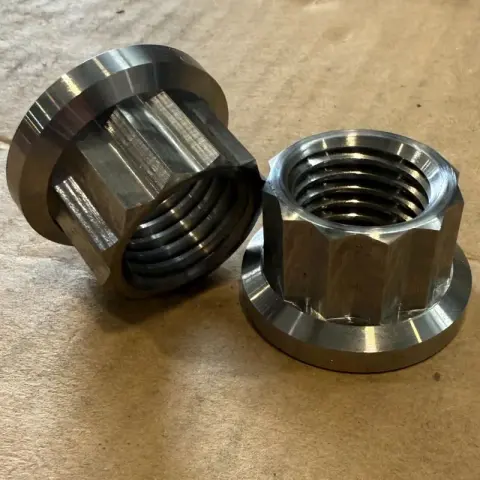
Jobs we’ve made in these grades.
Common questions.
Can you kit bolting by flange or joint number?
Yes. We count studs into sets from the ASME B16.5 or B16.47 table for each flange size and class, run on the nuts, and bag, box and label each set for the joint it belongs to. Send your flange list.
How early should we send the bolting list?
As early as you have it. A planned order leaves room for outside heat treatment, coating and testing; whatever arrives late is made as emergency work.
What if the turnaround finds bolting we did not plan for?
Call 832-446-3442; the line is answered 24/7. Gulf Coast sites get it on our own hot-shot, and we give you a delivery time on the call.
Do you ship turnaround bolting outside the Gulf Coast?
Yes. Everywhere else in the US and Canada we ship 2–4 days by ground, next-day air, or dedicated transport, and quote the delivery time with every order. Overseas we ship by international air or ocean freight from Houston, with the delivery time and shipping terms quoted on every order.
What certification comes with turnaround bolting?
Every lot ships with an EN 10204 3.1 material test report traceable to the heat, and each set's label carries the heat or lot number and cert number. EN 10204 3.2, PMI, Charpy and NACE MR0175 on request.