

Emergency A320 L7, L7M & L43 Low-Temperature Stud Bolts — 24/7
We make A320 L7, L7M and L43 stud bolts with A194 Grade 7 and 7M nuts for LNG, ethylene, ammonia and cold-climate flanges, and A320 B8 and B8M stainless for colder service still, in Houston. Call 832-446-3442, answered 24/7.
L7 is the low-temperature twin of B7: the same 4140-type steel, quenched and tempered, with Charpy impact testing at −150 °F. In a hurry, the impact test is what matters — the material has to carry Charpy results that meet A320 — and L7M adds a temper after machining and a hardness test on every piece for sour service.
What we make, and what happens after machining.
| Grade | UNS | After machining | Chosen for |
|---|---|---|---|
| A320 L7 | G41400 · G41420 · G41450 | Nothing — Q&T bar | 4140-type Cr-Mo, 125 ksi, Charpy tested at −150 °F. |
| A320 L7M | G41400 · G41420 · G41450 | Temper after machining, outside | 22 HRC max for cold sour service, NACE MR0175; Charpy at −100 °F. |
| A320 L43 | G43400 | Nothing — Q&T bar | 4340: L7 strength in diameters up to 4 in. |
| A194 7 | G41400 · G41420 · G41450 | Q&T nut | Grade 7 nuts, impact tested and marked L (7L), as A320 requires on L7. |
| A194 7M | G41400 · G41420 · G41450 | Q&T nut, 235 HBW max | The controlled-hardness nut for L7M. |
| A320 B8M Class 1 | S31600 | Nothing | 316 stainless to the low-temperature specification; impact exempt above −325 °F. |
| A320 B8 Class 1 | S30400 | Nothing | 304 stainless to the low-temperature specification for cryogenic piping. |
Where these parts go.
- LNG liquefaction, storage and regasification.
- Ethylene and propylene refrigeration loops.
- Ammonia plants and cold-box piping.
- Arctic and northern-climate plant flanges.
- Cryogenic valves and pumps.
- Any B7 joint with a low design temperature.
So we can start on the call.
- The grade (L7, L7M or L43) and the nut grade; L7 takes Grade 7 nuts marked L.
- Your design minimum temperature, if the impact test must be colder than the grade's own.
- Diameter, thread and length, or the flange list for sets.
- Any coating — applied outside, and it adds time.
The Charpy result is the part that matters.
- L7 and L43 from quenched-and-tempered bar with Charpy results: no heat treatment after threading.
- L7M is tempered after machining by an outside heat treater, and every piece is hardness tested to the 22 HRC limit.
- A Charpy test colder than the grade's own temperature, or on the finished lot, adds a test step — tell us at the start.
- For large diameters, L43 bar availability sets the date.
Heat treatment and coating are done by approved Houston processors, outside our shop. Every lot ships with an EN 10204 3.1 report; certification & traceability.
Order them at the start.
Charpy V-notch impact testing
A notched specimen machined from the lot is chilled to the test temperature and struck by a swinging hammer; the energy it absorbs before breaking is the result. Low-temperature grades must absorb a minimum energy at temperature, which is the difference between a B7 and an L7.
Is the heat treatment right, and is it soft enough for sour service?Hardness testing
A Rockwell or Brinell indenter is pressed into the part and the indentation measured. Hardness tracks the heat treatment, so it catches an under-tempered lot, and sour-service grades carry a hardness ceiling that every piece must meet.
Does it meet the strength table?Tensile testing
The full-size fastener is pulled to failure to prove the load it carries, and a specimen machined from the lot gives tensile strength, 0.2 percent offset yield, elongation and reduction of area. All are compared with the grade's table by diameter.
Any cracks or laps in the surface?Magnetic particle inspection (MPI)
The part is magnetised and dusted with fine iron particles, dry or in a fluorescent suspension. A crack, seam or lap at or just under the surface breaks the magnetic field and the particles gather along it, showing a defect the eye cannot see.
Is the alloy what the paperwork says?Positive Material Identification (PMI)
A handheld X-ray fluorescence analyser reads the chemistry of the finished part in seconds and matches it to the grade. It confirms that a B7 is chromium-molybdenum steel and not plain carbon, that a B8M has its molybdenum, and that a nickel-alloy stud is the alloy on the certificate. Handheld XRF does not read carbon, so carbon is confirmed from the mill certificate or by spark (OES) analysis.
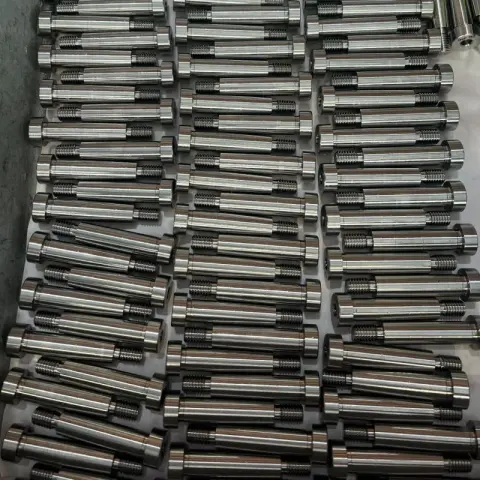
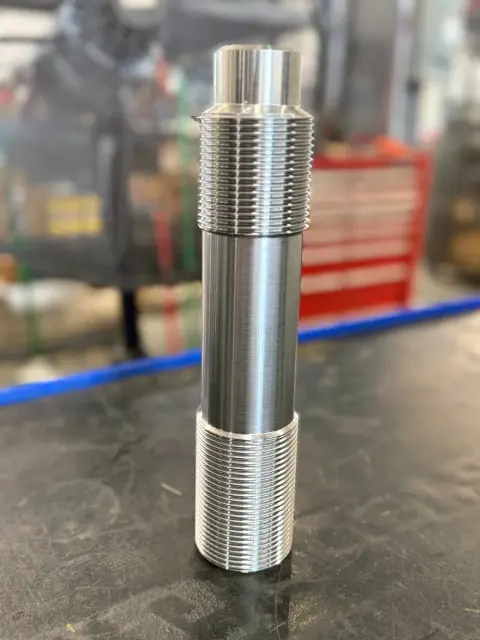
Jobs we’ve made in these grades.
Common questions.
Can I use B7 instead of L7?
Not where L7 is specified. The steel is the same, but L7 is impact tested for low-temperature service and a B7 stud carries no impact test. Use the grade the design calls for.
Which nut goes with an L7 stud?
ASTM A320 requires Grade 7 nuts on L7 studs, impact tested and marked L. For sour service, L7M studs take 7M nuts.
When is L43 used instead of L7?
For large diameters. 4340 hardens deeper than 4140, so L43 keeps L7 strength in diameters up to 4 in.
Are the Charpy results on the certificate?
Yes. The test temperature and the three impact values with their average go on the EN 10204 3.1 report with the heat number.