

Emergency B8 & B8M Stainless Stud Bolts — Class 1 & Class 2, 24/7
We make ASTM A193 and A320 B8 (304) and B8M (316) stud bolts in Class 1 and strain-hardened Class 2, the stabilised B8C (347) and B8T (321), and Nitronic 50 (B8R) and Nitronic 60 (B8S), with A194 Grade 8 and 8M nuts, in Houston. Call 832-446-3442, answered 24/7.
On an emergency stainless order, the class matters more than anything. Class 1 is carbide solution treated and much weaker than B7; Class 2 is strain hardened to near-B7 strength in small diameters, stepping down as the diameter grows. A replacement must be the class the joint was designed for.
What we make, and what happens after machining.
| Grade | UNS | After machining | Chosen for |
|---|---|---|---|
| A193 B8 Class 1 | S30400 | Nothing | 304, Class 1 — corrosion resistance from cryogenic temperatures to 1500 °F. |
| A193 B8 Class 2 | S30400 | Nothing — strain-hardened bar | 304 cold worked to 125 ksi in ¾ in. and under. |
| A193 B8M Class 1 | S31600 | Nothing | 316, Class 1 — molybdenum for chloride and pitting resistance. |
| A193 B8M Class 2 | S31600 | Nothing — strain-hardened bar | 316 cold worked to 110 ksi in ¾ in. and under; B8M2 / B8M3 for larger diameters. |
| A193 B8C Class 1 | S34700 | Nothing | 347, stabilised against sensitisation in hot service. |
| A193 B8T Class 1 | S32100 | Nothing | 321, stabilised against sensitisation in hot service. |
| A193 B8R | S20910 | Nothing | Nitronic 50 (XM-19): nearly twice the yield of 316, non-magnetic. |
| A193 B8S | S21800 | Nothing | Nitronic 60: anti-galling, for nuts and repeatedly assembled joints. |
| A194 8 | S30400 | Nothing | 304 heavy hex nut for B8. |
| A194 8M | S31600 | Nothing | 316 heavy hex nut for B8M. |
Where these parts go.
- Offshore topside, seawater cooling and desalination flanges (B8M).
- Chemical and pharmaceutical process piping.
- Water and wastewater plants, and food and beverage equipment (B8).
- LNG and cryogenic piping, to A320.
- Pulp and paper bleach plants.
- Hot stainless service where sensitisation is a risk (B8C, B8T).
So we can start on the call.
- The specification (A193 or A320), the grade and the class — Class 1 or Class 2.
- Size, thread and length, or the flange list for sets, and the nut grade.
- Any galling concern: Nitronic 60 nuts are made for it.
- Passivation or intergranular corrosion testing, if the spec calls for them.
Stainless bolting needs no heat treatment after machining.
- B8 and B8M in Class 1 and Class 2, and Nitronic 50 and 60, are machined from bar in its final condition and shipped.
- Class 2 strength steps down with diameter; large Class 2 studs may need the B8M2 or B8M3 classes, and bar in that condition.
- Passivation, when required, is done by an outside Houston processor.
- Intergranular corrosion testing, when the spec calls for it, adds a test step.
Heat treatment and coating are done by approved Houston processors, outside our shop. Every lot ships with an EN 10204 3.1 report; certification & traceability.
Order them at the start.
Positive Material Identification (PMI)
A handheld X-ray fluorescence analyser reads the chemistry of the finished part in seconds and matches it to the grade. It confirms that a B7 is chromium-molybdenum steel and not plain carbon, that a B8M has its molybdenum, and that a nickel-alloy stud is the alloy on the certificate. Handheld XRF does not read carbon, so carbon is confirmed from the mill certificate or by spark (OES) analysis.
Has the stainless been sensitized?Intergranular corrosion testing
Austenitic stainless that has formed chromium carbides along its grain boundaries can corrode along them. ASTM A262 screens with an oxalic acid etch (Practice A) and tests with acid exposures. Stainless bar and fastener specifications name Practice E: a copper–copper sulfate–sulfuric acid exposure followed by a bend test. Nickel alloys such as 625 and C-276 are tested to ASTM G28.
Does it meet the strength table?Tensile testing
The full-size fastener is pulled to failure to prove the load it carries, and a specimen machined from the lot gives tensile strength, 0.2 percent offset yield, elongation and reduction of area. All are compared with the grade's table by diameter.
Is the heat treatment right, and is it soft enough for sour service?Hardness testing
A Rockwell or Brinell indenter is pressed into the part and the indentation measured. Hardness tracks the heat treatment, so it catches an under-tempered lot, and sour-service grades carry a hardness ceiling that every piece must meet.
Surface defects on stainless and nickel alloysLiquid penetrant inspection (LPI)
A low-viscosity dye is drawn into any surface-breaking defect, the excess is cleaned off, and a developer pulls the trapped dye back out as a visible line. It does the job of magnetic particle inspection on materials that cannot be magnetised.
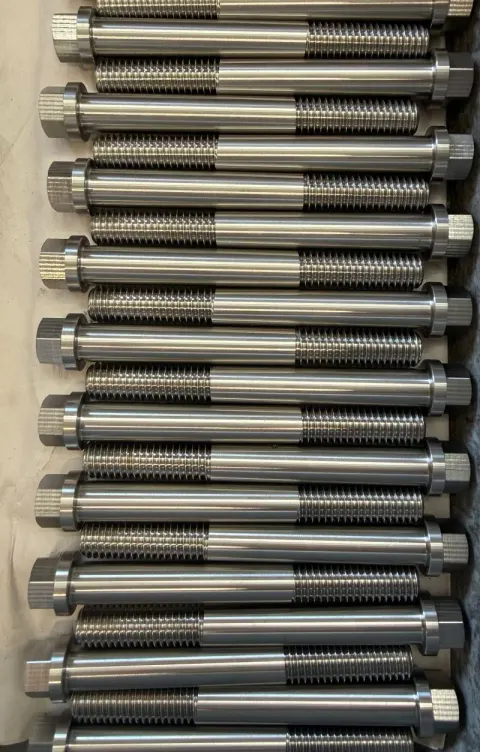
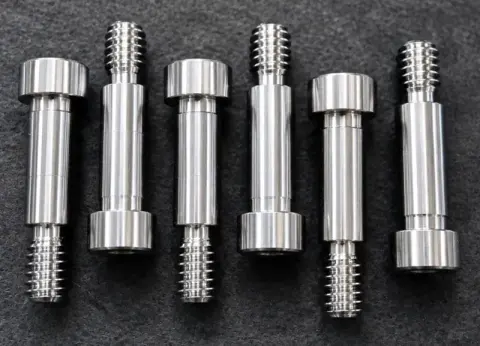
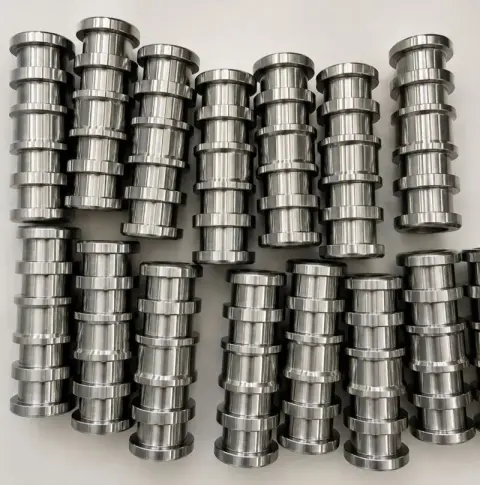
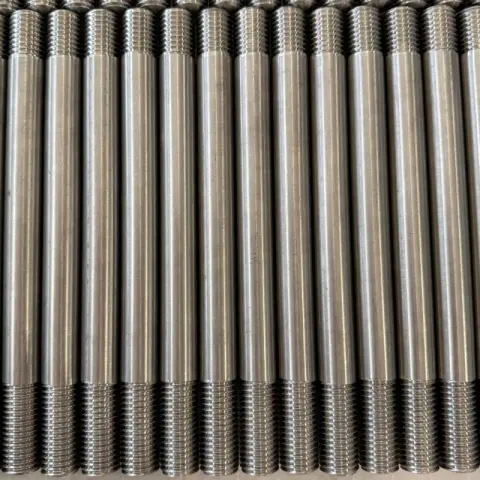
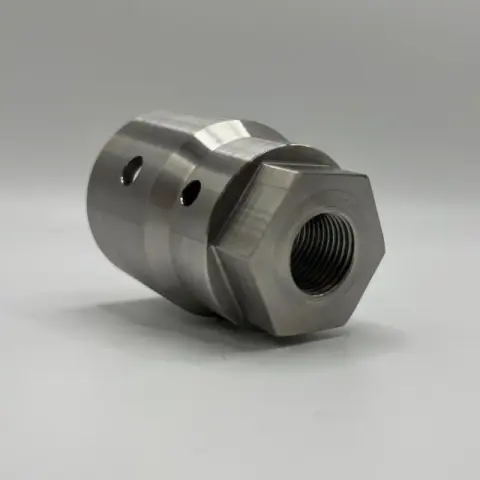
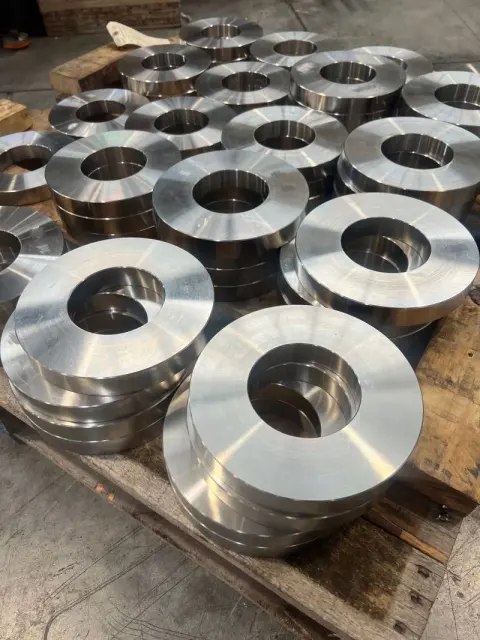
Jobs we’ve made in these grades.
Common questions.
What is the difference between B8 and B8M?
B8 is 304 stainless; B8M is 316, with molybdenum for chloride and pitting resistance. They look identical, so PMI is worth ordering when both are on site.
Class 1 or Class 2?
Class 1 is solution treated, for corrosion resistance at modest strength. Class 2 is strain hardened for strength close to B7 in small diameters. Use the class the joint was designed for; we do not substitute one for the other.
Why use Nitronic 60 nuts?
Nitronic 60 resists galling: silicon and manganese give it a wear-resistant surface, so nuts and threads assemble without seizing on stainless and Nitronic 50 studs.
A193 B8M or A320 B8M?
Same alloy, different specification: A320 is the low-temperature standard. A320 B8M Class 1 is impact-test exempt above −325 °F.