

Rush Duplex & Super Duplex Fasteners — 2205, 2507 & Zeron 100
We machine duplex 2205, super duplex 2507 and Zeron 100 (UNS S32760, F55) stud bolts, nuts, bolts and specials to size or to drawing in Houston. Call 832-446-3442 — answered 24/7 — for an emergency; Gulf Coast plants and yards get them on our own hot-shot.
Duplex is one of the quicker exotic grades to turn around. The bar is used solution annealed and duplex is not hardened by heat treatment, so nothing goes to the heat treater after machining. What sets the date is the bar, and any ferrite or corrosion testing the specification asks for.
What we make, and what happens after machining.
| Grade | UNS | After machining | Chosen for |
|---|---|---|---|
| Duplex 2205 | S31803 · S32205 | Nothing — solution annealed | Twice the yield strength of 316 with far better chloride stress-corrosion resistance; UNS S31803 / S32205. |
| Super Duplex 2507 | S32750 | Nothing — solution annealed | 25 Cr super duplex, PREN above 40, for the most aggressive seawater, sour and chloride bolting; UNS S32750. |
| Zeron 100 | S32760 | Nothing — solution annealed | Copper-tungsten super duplex with a guaranteed PREN of 40; the F55 grade, UNS S32760. |
Where these parts go.
- Offshore platform topside and subsea flange bolting.
- Subsea manifold, tree and connector bolting.
- Seawater cooling, firewater, lift and injection pumps.
- Sour gas and produced-water service.
- Desalination and reverse-osmosis plants.
- Chemical piping in chlorides, and pulp-mill digesters and bleach plants.
So we can start on the call.
- The grade and the specification: ASTM A1082 bolting, A276 / A479 bar, or the F51 / F53 / F55 designation, and any minimum PREN.
- Whether the spec calls for ferrite content or pitting corrosion tests.
- Size, thread and length, or the drawing, and the nut grade.
- If Zeron 100 is named, whether another mill's UNS S32760 is acceptable.
No heat treatment after machining.
- Duplex grades must not be held between 700 and 1800 °F, where sigma and other harmful phases form — so they are machined from annealed bar and shipped without heat treatment.
- Ferrite (phase balance) and pitting corrosion tests, when the specification calls for them, add a test step; say so at the start.
- Zeron 100 is one maker's S32760. If any S32760 / F55 to your specification will do, that widens the bar we can use.
- 2205, 2507 and S32760 look identical; PMI confirms the chromium, molybdenum and nickel against the grade.
Heat treatment and coating are done by approved Houston processors, outside our shop. Every lot ships with an EN 10204 3.1 report; certification & traceability.
Order them at the start.
Ferrite content and phase balance
A polished section of duplex stainless is point-counted to measure how much of it is ferrite. ASTM A923 shows whether harmful intermetallic phases such as sigma are present, by an etch screen, a Charpy test or a ferric chloride corrosion test. For austenitic parts that must be non-magnetic, relative magnetic permeability is measured instead.
Will it pit in chloride service?Pitting corrosion testing
Samples are exposed to ferric chloride solution to rank their resistance to pitting and crevice corrosion, or tested at a series of temperatures to find the critical pitting temperature. It is used on duplex, super duplex, 6% molybdenum austenitic grades and nickel alloys, and it shows whether the material lives up to its PREN.
Is the alloy what the paperwork says?Positive Material Identification (PMI)
A handheld X-ray fluorescence analyser reads the chemistry of the finished part in seconds and matches it to the grade. It confirms that a B7 is chromium-molybdenum steel and not plain carbon, that a B8M has its molybdenum, and that a nickel-alloy stud is the alloy on the certificate. Handheld XRF does not read carbon, so carbon is confirmed from the mill certificate or by spark (OES) analysis.
Is the heat treatment right, and is it soft enough for sour service?Hardness testing
A Rockwell or Brinell indenter is pressed into the part and the indentation measured. Hardness tracks the heat treatment, so it catches an under-tempered lot, and sour-service grades carry a hardness ceiling that every piece must meet.
Does it meet the strength table?Tensile testing
The full-size fastener is pulled to failure to prove the load it carries, and a specimen machined from the lot gives tensile strength, 0.2 percent offset yield, elongation and reduction of area. All are compared with the grade's table by diameter.
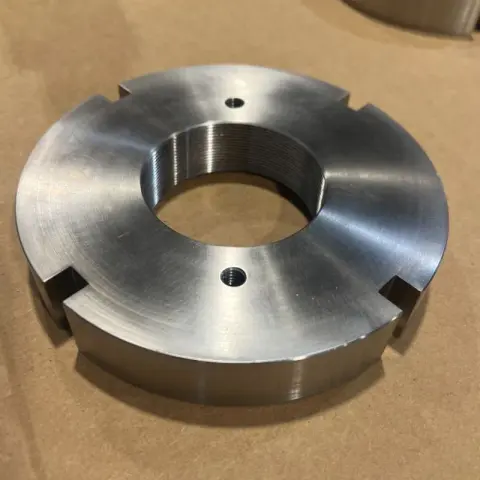
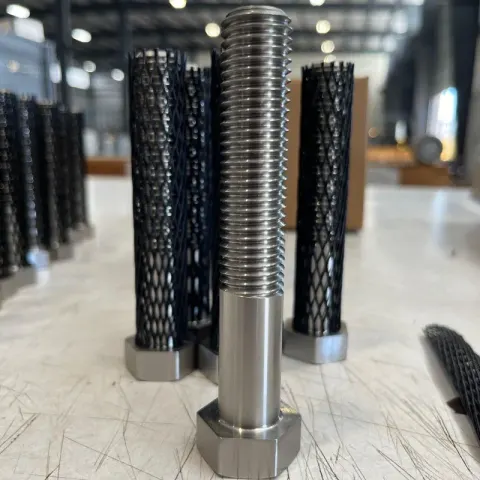
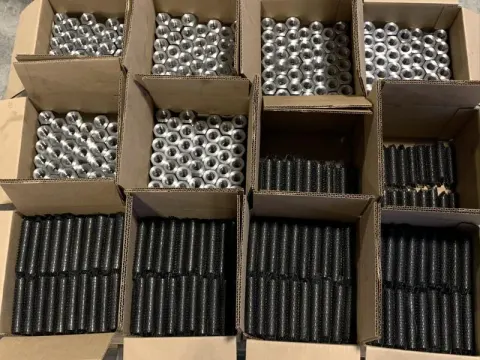
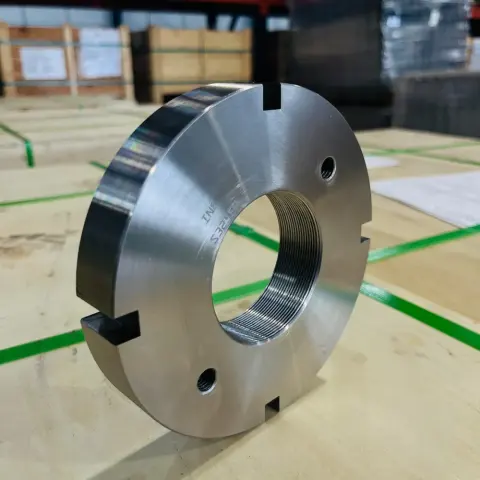
Jobs we’ve made in these grades.
Common questions.
Can you make super duplex studs fast?
Yes. Call 832-446-3442, answered 24/7. Super duplex needs no heat treatment after machining, so the date depends on the bar and any testing the spec asks for — we tell you on the call.
What is the difference between 2507 and Zeron 100?
Both are 25 Cr super duplex with a PREN above 40. Zeron 100 (UNS S32760) adds copper and tungsten and has a guaranteed PREN of 40; 2507 is UNS S32750. They are separate UNS numbers, so substitute only where your specification allows it.
Do duplex studs need heat treatment?
No. Duplex is not hardened by heat treatment; the bar is solution annealed and water quenched at the mill, and the parts are machined and shipped without further heating.
Is duplex used for sour service?
Yes, within the limits NACE MR0175 / ISO 15156 sets. We supply duplex and super duplex fasteners for CRA applications with the supporting certification.